Showing posts with label nyc. Show all posts

Friday, March 11, 2011

World's Tower Building: A 40th Street Gothic High-Rise in the Middle of Midtown Art Deco-land

A version of this post also appears on the Bryant Park blog.

Recently, there was shift of offices here at work. I went from sitting in an open area, sort of a combo - cubicle/bullpen setting, to a room with four walls, a door, and two windows that actually open (rare for a midtown office building).  Being able to somewhat control light and temperature levels and tell when it's dark outside is very nice. Like many working archivists, most of my former jobs took place in dreary basement-level rooms with poor air circulation (great when you are sorting through 30 year-old Thermofaxes layered in dust, or rotting photographs reeking of developing fixer solution) and no natural light. Now, I look out the window and see this building.

Photo: A. Kumer
Photo: A. Kumer


The World's Tower, at 110 West 40th Street, between Sixth Avenue and Broadway, has 30 above-ground levels, and a glazed terra cotta facade. When this Neo-Gothic building was completed in 1913, it was the tallest of its kind, on an extremely narrow, 50 foot-wide footprint, and made a striking impression in mid-town Manhattan.

Photo: MCNY
The architecture firm, Buchman & Fox, was commissioned by budding real estate magnate Edward W. Browning. According to New York Times Streetscapes columnist Christopher Gray, Browning was eccentric, throughout his life, steadily acquiring adoptive daughters (and marrying one), as well as skinny mid-block high-rises. You can also see part of the Empire (Eltinge) theater in the bottom right, with Billie Burke (later to play Glinda the Good Witch of the North in The Wizard of Oz) on the marquee.

Photo: BPC Collection
Behold, midtown, more or less as we know it now. The above photograph, taken in 1935, and looking south-west from above and across Bryant Park, shows numerous high-rise buildings surrounding the Tower. The Union Dime Savings Bank building is in the lower right of the above photograph, and Bryant Park is just west, outside the bottom frame of the photograph.

**Note: The eccentric Browning link may not work w/o a NYT login. It's worth it though, so maybe get one and read the article anyway. Sorry!

Tuesday, February 22, 2011

Happy Presidents' Day (Yesterday)!


February 22, 1732 marked the birth of our nation’s first President, George Washington. Now celebrated along with Abraham Lincoln's birthday as a federal holiday, Presidents' Day, on the third Monday of February. It's also an extra day off of work for many of us. 

In 1932, to celebrate the bicentennial of Washington's birth, the Washington Bicentennial Committee, headed by Sol Bloom  and Grover Whalen, was formed to erect a replica of Federal Hall just behind the NYPL, in Bryant Park. The original Federal Hall was located on Wall Street, and it was there that Washington took his first oath of office.


This building cost an estimated $8,000 to construct, and 25 cents per patron to enter. It stayed up for a little over a year after the celebration, mostly collecting dust and resentment. The faux Federal Hall stayed up for months, and was torn down in April 1933, at the urging of the Parks Department. The Commission was supposed to restore the park to its prior condition, but was thwarted by lack of funds. The often articulate barometer of widespread NYC sentiment, the New Yorker, referred to these as some of the park's "dreary years" in a December 1, 1934 article.

A much older, and slightly different version of this post is on the Bryant Park blog, posted around President's Day last year, and before I figured out what to do with pictures on blogs.

Wednesday, January 12, 2011

Tunnels Under Bryant Park, Part 1

This post also appears on the Bryant Park blog, and is the first of a two part entry on NYC subway trains near the park.
 
It's common knowledge that throughout the city, below ground, there is an intricate subway tunnel system that includes used and abandoned tunnels, passageways, and stations. Mass transit efforts began in NYC many years before the underground subway system was constructed in the early 1900s. The grid system for the streets was laid out in midtown Manhattan in 1807, and the first elevated trains appeared in the early 1870s. With tracks laced across the city, these above ground trains heralded all sorts of urban development, expansion, and helped put New York City on the map as a cosmopolitan destination.

In fact, if you ride several trains within the MTA system (full list, I think: 1, 4, 5, 6, 7, A, B, F, J, M, N, Q, R) far enough into Brooklyn, Queens, or the Bronx, you can experience the glory of above-ground transit, except now there is the added annoyance of overheard yelling cell phone conversations from fellow passengers. Not so in the 1800s, though I’m sure those passengers had their grievances too.

Image: NYPL

The above image shows the elevated station at Sixth Avenue and 42nd Street, looking east towards Fifth Avenue. The Croton Reservoir is visible on the right, as well as Bryant Park (then Reservoir Square), signified by that clump of trees just in front of the reservoir.

The train lines were owned and operated by several companies. The Metropolitan Elevated Railway Company built and ran the Sixth Avenue line; the New York Elevated Railroad handled the Third and Ninth Avenue lines; and the Suburban Rapid Transit Company took care of the Bronx section of the Third Avenue line. In 1902, a new company, the Interborough Rapid Transit Company (IRT) was incorporated and soon after, built an underground 9.1-mile long line that stopped at 28 stations between City Hall and 145th Street and Broadway. This was the City’s first official subway system, and opened on October 27, 1904, to much fanfare

Mid-section of the 1904 IRT subway map

Part of this line ran along the northern border of Bryant Park, along 42nd street, and connected Grand Central to Times Square (now known as the S Shuttle). 

Photo: NY Transit Museum

The photograph above is a pedestrian-level view of the construction on 42nd Street, looking east, with Bryant Park to the right, and 42nd Street to the left. The monument on the right is J. Marion Simms -- "father of gynecology" -- who now stands across from the Academy of Medicine on Fifth Avenue at 103rd Street in Manhattan.

For more historical subway facts, take a look at the MTA's fact's and figures page, and for pictures, check out this NY Times slideshow.

Tuesday, December 14, 2010

Union Dime: Saved Dimes Turn into Prime Real Estate

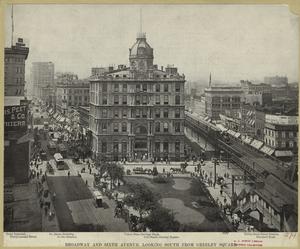
In 1859, a group of thirty four business men founded and chartered a mutual savings bank. They named it Union Dime Savings Institute to show solidarity with the Federal Union as well as remind people that “dimes saved increased to dollars.”  They were also the first banking institution to use the word "Dime" in its title, though others soon followed. The bank first opened a modest office at Canal and Varick Streets. In 1867, they moved their headquarters to Canal and Laight Streets, and in 1876, to 32nd and Broadway:

Broadway and Sixth Avenue, loo... Digital ID: 809713. New York Public Library
photo: NYPL Digital Collection

This six-story white marble building was built in 1874, and in October of that year, Union Dime Savings Institute bought the title of the property from Rudolph A. Witthaus, for $275,000, nearly $70 per square foot. This was considered a fair amount of money for a neighborhood that hadn't quite achieved its desirable reputation.

Greeley Square, c. 1908, with the elevated 6th Avenue train station on the right.

The front façade faced Greeley Square and 32nd Street, and the building housed the Union Dime offices as well as apartments on its upper floors.  The bank remained there for the next 34 years before moving uptown eight blocks to the corner of 40th Street and 6th Avenue. The old building at 32nd sold for a record high price of $1,000,000, or, about $250 a square foot. Aside from making news for its price tag, the deal aroused interest because the purchasers, City Investing Company, didn’t own any adjacent property, or have any plans for the space or building, suggesting to many, an intention to flip the property for a higher price.  

At around the turn of the century, the 34th Street district was going through a massive transition. Improvements in mass transit led to the arrival of retail giants Macy’s, whose flagship store was built in 1901-1902, and Gimbels (1910).  The 6th Avenue elevated train had been operating since 1878, but the early 1900s also saw the addition of the “Hudson Tubes” (New Jersey PATH train), and the completion of Pennsylvania Station in 1910. Additionally, the Hotel Martinique on 32nd Street and Broadway finished its third phase of completion in 1910-1911, rounding out the district as a new hub for retail, transportation, and hospitality.


Regardless of the rise of the 34th Street district, in 1908, Union Dime purchased the corner lot on 40th Street and 6th Avenue, across from Bryant Park, for $1,000,000. (Many also know the block between 5th and 6th Aves on 40th Street as the longtime home of the Tesla Society, named after the inventor of wireless communication and alternating current electricity, Nikola Tesla.) Five row houses were demolished to make room for what The Independent referred to as “one of the most imposing banking edifices in the city” (vol. 68, p. 664). The Italian Renaissance building was designed by architect Alfred Taylor, and featured a 96 x 85 foot main banking room with 48 ft. tall ceilings.

View from Bryant Park (known then as Reservoir Square) looking towards 6th Ave. 40th Street is along the left. Photo, NYPL


View of the South side of the Union Dime building on 40th Street, looking east toward the park and the NYPL building. Photo, NYPL


I'm not sure when this building was torn down, but it was still there in the 1930s (upper left, just behind the 6th Avenue elevated train line):


And, in the 1950s, when this subway map was published and distributed by Union Dime:


It was probably torn down sometime in the mid-1950s, to make way for a 34-story office building designed by Kahn and Jacobs, and Sydney Goldstone. The building was completed in 1957, and is still there, looking much the same as it did in 1959, when a photo of it was published on the cover of Union Dime's 100th Anniversary booklet.


**Special thanks to Mr. Boyd Lewis at Union Dime, Inc. for his insight and interest, and a copy of the Union Dime 1959 yearbook.


Monday, November 22, 2010

The New York Public Library Lays Its Cornerstone

This post also appears on the Bryant Park blog, and was posted on November 10, 2010, the same day it should have been also posted here. (oops. vacation brain . . . )

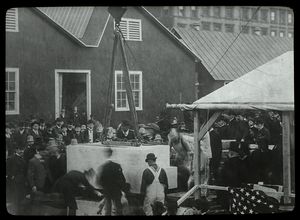
On November 10, 1902, a hundred and eight years ago (and twelve days), the first cornerstone of the New York Public Library's Central Building was laid. One of New York City's architectural treasures, the NYPL borders Bryant Park on the east, along Fifth Avenue between 42nd and 40th Streets. It is also the former location of the Croton Distributing Reservoir.

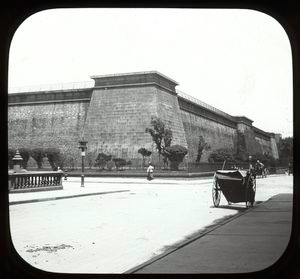
Croton reservoir : 42nd Street... Digital ID: 465503. New York Public Library
                A pedestrian level view of the Croton Distributing Reservoir at the corner of 42nd Street and Fifth Ave.                        Photo: NYPL Digital Gallery

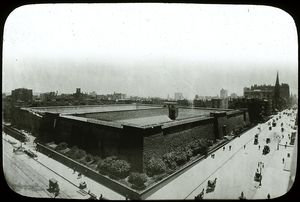
Croton reservoir in 1900, in p... Digital ID: 465501. New York Public Library
Overview of the reservoir, seen from the corner of Fifth Ave. and 42nd Street, 1900. Photo: NYPL Digital Gallery

Plans for the formation of a grand public library began in the late 1800s, when a group of prominent New York citizens agreed that the city, growing rapidly in population and international importance, needed a library. The site of the Croton Reservoir was chosen as the location, and a competition was announced for the building's design. The winning architects, John Merven Carrere and Thomas Hastings of architecture firm Carrere and Hastings, submitted a Beaux-Arts proposal, with a raised terrace at the rear of the building, and two comfort stations along the east end of neighboring Bryant Park (then called Reservoir Square).


Central building, cornerstone ... Digital ID: 465291. New York Public Library
Cornerstone laying, 1902. Photo: NYPL Digital Collection

[Exterior marble work : west f... Digital ID: 489442. New York Public Library
View of the west facade of the library during construction, 1903. Photo: NYPL Digital Collection


View from the construction site of the NYPL. Bryant Park, then called Reservoir Square, can be seen on the left, 1906. Photo: NYPL Digital Collection
It was the largest marble structure ever attempted in the United States, and took nine years to complete, with a cost totaling over nine million dollars. In 1906, the roof of the building was completed, and designers set to work for five additional years on the interior. Dr. John Shaw Billings, the first director of the New York Public Library, created a plan for an enormous reading room, seven floors of stacks, and an efficient retrieval system.

Interior construction, 1909. Photo: NYPL Digital Gallery


Carrere and Hastings furniture plans. Image: NYPL Digital Gallery

The main branch of the New York Public Library opened to the public on May 23, 1911.


Postcard of the NYPL showing the north and east facades. Postcard: Bryant Park Corporation / 34th Street Partnership

To read more about the history of the NYPL and its buildings, click here, and to search though historic photos on the NYPL's digital gallery, look here.


Friday, November 19, 2010

NYC Monuments: William Earle Dodge


This post also appears on the Bryant Park blog.

Sometimes it seems as if New York’s monuments and statues move about the city's boroughs as much as its citizens do. Often, they will be relocated from one public space to another, because of construction, the whims of city officials, or convenience. The stories of monument preservation, placement, and movement from one park or square to another provide insight to the nature of the public places where they stand.

One in particular, William Earle Dodge, who currently resides midway through Bryant Park's 42nd Street allée, was first dedicated in Herald Square Park, located within one of our sister business improvement districts, the 34th Street Partnership.


Overhead view of Herald Square, showing the Dodge monument, Herald building, and 6th Avenue elevated train, c. late 1930s. Photo: NYC Parks Department

William Earle Dodge was best known as a founder of the successful copper and metals company Phelps Dodge & Co. He also helped start the Young Men's Christian Association (YMCA), and staunchly supported the Prohibition Movement. He served as President of the National Temperance Society from 1865 to 1883, and was instrumental in the publication of over 2,000 supporting books, pamphlets, and posters.


Pedestrian view showing the Dodge monument in Herald Square, c. late 1800s. Postcard: Bryant Park Corporation / 34th Street Partnership

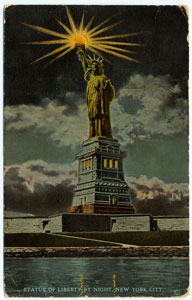
When he died, friends formed a commemorative committee to erect a statue in his honor. This statue was sculpted by John Quincy Ward, and placed on a base designed by Richard Morris Hunt. Among Hunt’s many accomplishments, which include founding the American Institute of Architects (AIA), he also designed the base for the Statue of Liberty, as well as the façade and Great Hall of the Metropolitan Museum of Art.

Statue of Liberty by night, Ne... Digital ID: 836991. New York Public Library
Lady Liberty. Postcard: NYPL Digital Collection
Hunt’s base for the Dodge monument featured a water fountain and small lion’s head, a nod to Dodge’s commitment to temperance. Literature buffs too, will also recognize the inherent symbolism in the lion’s head - commonly used to suggest stateliness, leadership, and reverence.

Pedestrian view of the Dodge monument, 1914. Photo: NYC Transit Museum

Dedicated on October 22, 1885, the statue presided there, in the company of the Herald Building, until Herald Square was refurbished in 1940.

One year later, in 1941, Dodge was moved to the Northeast corner of Bryant Park, and placed on a granite pedestal. The original Hunt pedestal was removed from Herald Square; its current whereabouts are unknown.

Partial view of a 1939 architectural plan detailing the granite pedestal for the Dodge statue once moved to Bryant Park. Map: NYC Parks Department

Dodge remained in the northeast corner of the park, in close proximity to another publisher and philanthropist, William Cullen Bryant, until the 1992 renovation of the park.

Profile view of Dodge on the upper terrace in Bryant Park, 1983. Note the absence of the Bryant Park Cafe. Photo: Bryant Park Corporation / 34th Street Partnership

Rear view of Dodge on the upper terrace, nine years before his (and the park's) restoration. Photo: Bryant Park Corporation / 34th Street partnership

At that point, Dodge underwent a $23,000 renovation, and was moved again in the park to his present location, along the 42nd Street allée, where the Bryant Park Reading Room is located during the warmer months, and currently, the Holiday Shops.


Tuesday, November 2, 2010

Bryant Park's 1934 Moses Renovation

This post also appears on the Bryant Park Blog.

Over the years, Bryant Park has undergone numerous physical transformations. Some temporary, such as Citi Pond at Bryant Park -- which, to the delight of ice skaters, opened last Friday, October 29 -- and others more permanent, such as the 1934 renovation of the park headed by then Parks Commissioner Robert Moses.

Assisted by consulting architect Aymar Embury II, and landscape architect Gilmore D. Clarke, Moses transformed the grounds of Bryant Park from a Victorian greensward to a French Classical landscape very similar to today’s design.

Bryant Park, circa 1930
Before Moses set to work, Bryant Park was laced with winding paths, broken up by small clumps of trees, and lined with wood and cast iron benches, common elements in Victorian Era landscaping. The paths encouraged park visitors to meander, while the trees provided shade as well as an air of mystery to what lay directly ahead on the path. The benches supplied a bit of ornamentation as well as seating for patrons.

As part of the Moses Renovation, the Josephine Shaw Lowell Memorial Fountain was moved from the east end of the park, directly in front of the William Cullen Bryant monument, to the west end at 41st Street and 6th Avenue, where it sits today on what we call the Fountain Terrace. 

Construction in Bryant Park, May 1934, before the fountain was moved to its present location. Prior to 1934, it was located on the east end of the park, just behind the New York Public Library. Photo: NYC Parks Department

Taken in June 1934, this photo shows the present location of the Josephine Shaw Lowell Memorial Fountain on the west side of the park. Photo: NYC Parks Department
An expansive lawn was added in the center of the park space. London Plane trees were planted along allées lining two sides of the lawn’s perimeter, which was also bordered by a stone balustrade.

The park re-opened to the public on September 14, 1934.

Mid-1930s postcard showing the park after the Moses Renovation.
To learn more about Bryant Park’s history, before and after the Moses Renovation, click here.

Thursday, September 23, 2010

Washington Irving in Bryant Park

This post also appears on the Bryant Park blog.  

Currently, the Bryant Park grounds are home to several monuments that pay homage to artists, writers, and leaders. Some, such as the statue memorializing William Earle Dodge in the Reading Room, originally stood in other parks and courtyards throughout the city before making their way to Bryant Park. (Dodge’s original home was Herald Square.) Others, such as a bust of American author Washington Irving, resided first in the park, and have since been moved elsewhere.

My interest was first piqued when I found (and bought) this postcard at the Brooklyn Flea. In case you can't read the back, it says "Same old story" and nothing else. A perfect non sequitur circa 1914.

front

back


In the late 1800s to early 1900s, a large bronze bust of Washington Irving, mounted on a granite pedestal, stood in the south side of Bryant Park. The author of “Sleepy Hollow” and many other works, Irving was one of the first American writers to gain international acclaim. 


The statue was donated to the City of New York in 1885 by Joseph Weiner, a German physician and admirer of Irving’s. Sculpted by artist Friedrich Beers, the bust was originally intended for placement in Central Park. Upon completion some members of the NYC Art Committee declared it a success, while others insisted that it wasn’t flattering enough to Irving. The Commission decided to put the bust in Bryant Park, because Irving had served on the park’s advisory council at one point.


It remained in the park for many years, and possibly up until the 1934 renovation. Some say that the statue was moved before that, lost, and then later recovered in a storage shed under the Williamsburg Bridge.

In 1935, the Irving bust was moved to Washington Irving High School (go bulldogs!), where it remains today.

Look here for more details on the history of this and many other NYC statues, and of course, here, for more information about NYC parks, including the other Washington Irving bust, located in Brooklyn's Prospect Park.

Thursday, August 26, 2010

Facades to Pedestals


In the middle of midtown shopping and tourist chaos, at 34th Street, where Broadway and 6th Avenue meet, is a small park maintained by one of my employers, the 34th Street Partnership, called Herald Square. This small triangle of land was named after the New York Herald, a daily newspaper established in 1835 by James Gordon Bennett, Sr. (1795-1872). Known primarily for its sensationalistic coverage of crime and scandal, as well as a massive national circulation, the Herald set up its headquarters at the north end of this small green space in 1894, in a two story arcaded building designed by architecture firm McKim, Mead, and White.


postcard from around 1898 showing the Herald building, as well as the Dodge monument

The ornate building featured several bronze owls mounted along the façade as well as statues of Minerva and two bell-ringing blacksmiths, nicknamed “Stuff and Guff” or “Gog and Magog.”

At this time, the James Earle Dodge monument, now in Bryant Park, occupied a stately position in front of the Herald building. More on him later . . .


Minerva on top of the Herald, and later, as part of the James Gordon Bennett monument


In 1918, the Herald moved its offices to 42nd street, and three years later, the statues were removed from the building’s façade. They went into the possession of William Dewart, then proprietor of the New York Sun. Years later, in 1940, when Herald Square underwent a massive renovation, the statues were given to the city on permanent loan and placed in a Milford granite pedestal in Herald Square Park. The pedestal, designed by architect Aymar Emburry II, along with the statues from the Herald building make up a monument to James Gordon Bennett. The dedication ceremony was held on November 19, 1940.


Before and After contrast

Sunday, August 22, 2010

Library Under the Lawn

This post also appears on the Bryant Park blog. All photos, Bryant Park Corporation. 

In 1983 the Bryant Park Corporation retained landscape architecture firm Hanna / Olin Ltd., now The Olin Studio, for the re-design of Bryant Park. Over the next several years, plans were drafted and the park began its transition into a beautiful, well used public space.

Concurrent with Bryant Park’s facelift, the New York Public Library embarked on a large construction project of its own: the addition of 120,000 square feet of library stacks beneath the surface of the Bryant Park lawn.


The excavation for the two story stacks began in July 1988, with Tishman Realty & Construction Co., Ltd. managing construction.

Requiring a 30 foot excavation in the center of the park, the finished stacks accommodate up to 3.2 million books and 500,000 reels of microfilm, doubling the library’s storage capacity.  The stacks are connected to the main library by a 62 foot long tunnel. Additionally, there is a fire escape on the west side of the Bryant Park lawn, disguised by a dedication plaque.
           

The stacks took less than a year to complete, and the lawn was seeded, and in place by September 15, 1989. The park partially reopened to the public in spring of 1990.