Showing posts with label statues. Show all posts

Friday, November 19, 2010

NYC Monuments: William Earle Dodge


This post also appears on the Bryant Park blog.

Sometimes it seems as if New York’s monuments and statues move about the city's boroughs as much as its citizens do. Often, they will be relocated from one public space to another, because of construction, the whims of city officials, or convenience. The stories of monument preservation, placement, and movement from one park or square to another provide insight to the nature of the public places where they stand.

One in particular, William Earle Dodge, who currently resides midway through Bryant Park's 42nd Street allée, was first dedicated in Herald Square Park, located within one of our sister business improvement districts, the 34th Street Partnership.


Overhead view of Herald Square, showing the Dodge monument, Herald building, and 6th Avenue elevated train, c. late 1930s. Photo: NYC Parks Department

William Earle Dodge was best known as a founder of the successful copper and metals company Phelps Dodge & Co. He also helped start the Young Men's Christian Association (YMCA), and staunchly supported the Prohibition Movement. He served as President of the National Temperance Society from 1865 to 1883, and was instrumental in the publication of over 2,000 supporting books, pamphlets, and posters.


Pedestrian view showing the Dodge monument in Herald Square, c. late 1800s. Postcard: Bryant Park Corporation / 34th Street Partnership

When he died, friends formed a commemorative committee to erect a statue in his honor. This statue was sculpted by John Quincy Ward, and placed on a base designed by Richard Morris Hunt. Among Hunt’s many accomplishments, which include founding the American Institute of Architects (AIA), he also designed the base for the Statue of Liberty, as well as the façade and Great Hall of the Metropolitan Museum of Art.
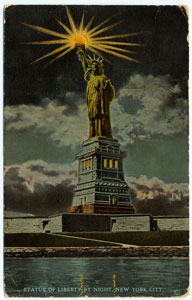
Statue of Liberty by night, Ne... Digital ID: 836991. New York Public Library
Lady Liberty. Postcard: NYPL Digital Collection
Hunt’s base for the Dodge monument featured a water fountain and small lion’s head, a nod to Dodge’s commitment to temperance. Literature buffs too, will also recognize the inherent symbolism in the lion’s head - commonly used to suggest stateliness, leadership, and reverence.

Pedestrian view of the Dodge monument, 1914. Photo: NYC Transit Museum

Dedicated on October 22, 1885, the statue presided there, in the company of the Herald Building, until Herald Square was refurbished in 1940.

One year later, in 1941, Dodge was moved to the Northeast corner of Bryant Park, and placed on a granite pedestal. The original Hunt pedestal was removed from Herald Square; its current whereabouts are unknown.

Partial view of a 1939 architectural plan detailing the granite pedestal for the Dodge statue once moved to Bryant Park. Map: NYC Parks Department

Dodge remained in the northeast corner of the park, in close proximity to another publisher and philanthropist, William Cullen Bryant, until the 1992 renovation of the park.

Profile view of Dodge on the upper terrace in Bryant Park, 1983. Note the absence of the Bryant Park Cafe. Photo: Bryant Park Corporation / 34th Street Partnership

Rear view of Dodge on the upper terrace, nine years before his (and the park's) restoration. Photo: Bryant Park Corporation / 34th Street partnership

At that point, Dodge underwent a $23,000 renovation, and was moved again in the park to his present location, along the 42nd Street allée, where the Bryant Park Reading Room is located during the warmer months, and currently, the Holiday Shops.


Thursday, September 23, 2010

Washington Irving in Bryant Park

This post also appears on the Bryant Park blog.  

Currently, the Bryant Park grounds are home to several monuments that pay homage to artists, writers, and leaders. Some, such as the statue memorializing William Earle Dodge in the Reading Room, originally stood in other parks and courtyards throughout the city before making their way to Bryant Park. (Dodge’s original home was Herald Square.) Others, such as a bust of American author Washington Irving, resided first in the park, and have since been moved elsewhere.

My interest was first piqued when I found (and bought) this postcard at the Brooklyn Flea. In case you can't read the back, it says "Same old story" and nothing else. A perfect non sequitur circa 1914.

front

back


In the late 1800s to early 1900s, a large bronze bust of Washington Irving, mounted on a granite pedestal, stood in the south side of Bryant Park. The author of “Sleepy Hollow” and many other works, Irving was one of the first American writers to gain international acclaim. 


The statue was donated to the City of New York in 1885 by Joseph Weiner, a German physician and admirer of Irving’s. Sculpted by artist Friedrich Beers, the bust was originally intended for placement in Central Park. Upon completion some members of the NYC Art Committee declared it a success, while others insisted that it wasn’t flattering enough to Irving. The Commission decided to put the bust in Bryant Park, because Irving had served on the park’s advisory council at one point.


It remained in the park for many years, and possibly up until the 1934 renovation. Some say that the statue was moved before that, lost, and then later recovered in a storage shed under the Williamsburg Bridge.

In 1935, the Irving bust was moved to Washington Irving High School (go bulldogs!), where it remains today.

Look here for more details on the history of this and many other NYC statues, and of course, here, for more information about NYC parks, including the other Washington Irving bust, located in Brooklyn's Prospect Park.

Thursday, August 26, 2010

Facades to Pedestals


In the middle of midtown shopping and tourist chaos, at 34th Street, where Broadway and 6th Avenue meet, is a small park maintained by one of my employers, the 34th Street Partnership, called Herald Square. This small triangle of land was named after the New York Herald, a daily newspaper established in 1835 by James Gordon Bennett, Sr. (1795-1872). Known primarily for its sensationalistic coverage of crime and scandal, as well as a massive national circulation, the Herald set up its headquarters at the north end of this small green space in 1894, in a two story arcaded building designed by architecture firm McKim, Mead, and White.


postcard from around 1898 showing the Herald building, as well as the Dodge monument

The ornate building featured several bronze owls mounted along the façade as well as statues of Minerva and two bell-ringing blacksmiths, nicknamed “Stuff and Guff” or “Gog and Magog.”

At this time, the James Earle Dodge monument, now in Bryant Park, occupied a stately position in front of the Herald building. More on him later . . .


Minerva on top of the Herald, and later, as part of the James Gordon Bennett monument


In 1918, the Herald moved its offices to 42nd street, and three years later, the statues were removed from the building’s façade. They went into the possession of William Dewart, then proprietor of the New York Sun. Years later, in 1940, when Herald Square underwent a massive renovation, the statues were given to the city on permanent loan and placed in a Milford granite pedestal in Herald Square Park. The pedestal, designed by architect Aymar Emburry II, along with the statues from the Herald building make up a monument to James Gordon Bennett. The dedication ceremony was held on November 19, 1940.


Before and After contrast