Showing posts with label monuments. Show all posts

Wednesday, November 30, 2011

The Lost Generation Occupies Some City Green

This post also appears on the Bryant Park blog.

At this time of year, the life-sized bronze Gertrude Stein statue is somewhat buried behind the holiday shops in Bryant Park. She is one of ten made from a cast by friend and sculptor Jo Davidson in Paris, in 1922, and possibly the only one displayed outdoors year-round. Davidson had a long list of commissioned busts, including Charlie Chaplin, Hellen Keller, and Frank Sinatra. Many of them can be seen here. The photo below, taken by friend and surrealist photographer Man Ray, shows Davidson working in his Paris studio, with his subject Gertrude Stein looking on.

Photo: Man Ray, 1922, Getty Museum

Stein was connected to the ex-pat art and literary scene of the times, coining the term "lost generation," later used by Hemingway to refer to that generation of authors: "You are all a lost generation," epigraph, The Sun Also Rises. Though most well-known for her writing and personal relationships, Stein, along with several members of her family, amassed an impressive art  collection, on display at the Grand Palais now until mid-January.Time to use up those miles!

The Bryant Park statue was donated by Dr. Maury Leibovitz, psychologist and art dealer, and unveiled in a small ceremony on November 5, 1992. In addition to the sculpture, Mr. Leibovitz owned an estate formerly belonging to Jo Davidson. Davidson has another Bryant Park connection -- for a time, he worked out of a studio at the Bryant Park Studios, on the corner of 40th Street and Sixth Avenue. So it's fitting that she found a home in the park.

Photo: BPC, Marco Castro

As for the other nine statues, I tracked down a few of them: one at The Met (they also have a beautiful Picasso portrait of her), supposedly one each at The Whitney and The Carnegie Museum of Art, and possibly one at The Smithsonian (it was on view last Spring, but could have been on loan).
  
Other Sources:
**The Parks Department has a monuments catalog available online. You can read about most every statue you've ever seen in the park system until your eyes bleed.
**Now you can settle all of those arguments about when the Post Modern ends and Contemporary begins with this handy chart.

Tuesday, August 23, 2011

One for the Ladies: The Josephine Shaw Lowell Memorial Fountain

This post also appears on the Bryant Park blog.

One of the park's oldest and most beautiful monuments is also the first public city monument dedicated to a woman -- the Josephine Shaw Lowell Memorial Fountain. Designed by architect, landscape designer, and painter Charles Adams Platt, the fountain was originally intended for Corlear's Hook Park in the Lower East Side -- where Shaw Lowell had done the majority of her work -- but was instead erected in Bryant park on the east side, near the William Cullen Bryant monument, and behind the New York Public Library.

The Lowell fountain seen here in it's first location at the east end of the park, just behind the NYPL, 1922. Photo: NYC Transit Museum


This pink granite fountain, with a 32-foot diameter base, and 13-foot diameter upper basin mounted on a classical pedestal was dedicated on May 21, 1912. As part of the 1934 Moses renovation of the park it was moved to its present location, at the west side of the park, near Sixth Avenue.

Bryant Park, seen from the elevated Sixth Avenue train facing east, 1936. Postcard: BPC


Josephine Shaw Lowell's life was devoted to helping those in need. (Oh, the digital age -- you can even "like" her on facebook!) Shortly after she married Charles Russel Shaw, she joined her husband on the front lines of the American Civil War in Virginia, tending to sick and wounded soldiers, and later, was the first woman appointed a Commissioner to the New York State Board of Charities.

The Shaw Lowell fountain, the day of Bryant Park's re-opening after the Moses renovation, September 14, 1934. Photo: New York City Parks Photo Archive
Embedded in the bluestone at the fountain's base, is a commemorative plaque.

Photo: Jacob Bielecki, BPC
THIS FOUNTAIN COMMEMORATES
JOSEPHINE SHAW LOWELL
1843-1905
WIFE FOR ONE YEAR OF A PATRIOT SOLDIER
WIDOW AT TWENTY ONE
SERVANT OF NEW YORK STATE AND CITY IN THEIR PUBLIC CHARITIES
SINCERE AND CANDID COURAGEOUS AND TENDER
BRINGING HELP AND HOPE TO THE FAINTING
INSPIRING OTHERS TO CONSECRATED LABOR

Ninety-nine years after its dedication, the Josephine Shaw Lowell fountain continues to amaze and inspire New Yorkers (watch carefully at the 1:30 mark), local news stations, and numerous park visitors, especially during colder months when the fountain is winterized and looks like this. In warmer moths it also serves as an ad hoc wishing well. Ever wonder what happens with the coins?

Wednesday, January 12, 2011

Tunnels Under Bryant Park, Part 1

This post also appears on the Bryant Park blog, and is the first of a two part entry on NYC subway trains near the park.
 
It's common knowledge that throughout the city, below ground, there is an intricate subway tunnel system that includes used and abandoned tunnels, passageways, and stations. Mass transit efforts began in NYC many years before the underground subway system was constructed in the early 1900s. The grid system for the streets was laid out in midtown Manhattan in 1807, and the first elevated trains appeared in the early 1870s. With tracks laced across the city, these above ground trains heralded all sorts of urban development, expansion, and helped put New York City on the map as a cosmopolitan destination.

In fact, if you ride several trains within the MTA system (full list, I think: 1, 4, 5, 6, 7, A, B, F, J, M, N, Q, R) far enough into Brooklyn, Queens, or the Bronx, you can experience the glory of above-ground transit, except now there is the added annoyance of overheard yelling cell phone conversations from fellow passengers. Not so in the 1800s, though I’m sure those passengers had their grievances too.

Image: NYPL

The above image shows the elevated station at Sixth Avenue and 42nd Street, looking east towards Fifth Avenue. The Croton Reservoir is visible on the right, as well as Bryant Park (then Reservoir Square), signified by that clump of trees just in front of the reservoir.

The train lines were owned and operated by several companies. The Metropolitan Elevated Railway Company built and ran the Sixth Avenue line; the New York Elevated Railroad handled the Third and Ninth Avenue lines; and the Suburban Rapid Transit Company took care of the Bronx section of the Third Avenue line. In 1902, a new company, the Interborough Rapid Transit Company (IRT) was incorporated and soon after, built an underground 9.1-mile long line that stopped at 28 stations between City Hall and 145th Street and Broadway. This was the City’s first official subway system, and opened on October 27, 1904, to much fanfare

Mid-section of the 1904 IRT subway map

Part of this line ran along the northern border of Bryant Park, along 42nd street, and connected Grand Central to Times Square (now known as the S Shuttle). 

Photo: NY Transit Museum

The photograph above is a pedestrian-level view of the construction on 42nd Street, looking east, with Bryant Park to the right, and 42nd Street to the left. The monument on the right is J. Marion Simms -- "father of gynecology" -- who now stands across from the Academy of Medicine on Fifth Avenue at 103rd Street in Manhattan.

For more historical subway facts, take a look at the MTA's fact's and figures page, and for pictures, check out this NY Times slideshow.

Friday, November 19, 2010

NYC Monuments: William Earle Dodge


This post also appears on the Bryant Park blog.

Sometimes it seems as if New York’s monuments and statues move about the city's boroughs as much as its citizens do. Often, they will be relocated from one public space to another, because of construction, the whims of city officials, or convenience. The stories of monument preservation, placement, and movement from one park or square to another provide insight to the nature of the public places where they stand.

One in particular, William Earle Dodge, who currently resides midway through Bryant Park's 42nd Street allée, was first dedicated in Herald Square Park, located within one of our sister business improvement districts, the 34th Street Partnership.


Overhead view of Herald Square, showing the Dodge monument, Herald building, and 6th Avenue elevated train, c. late 1930s. Photo: NYC Parks Department

William Earle Dodge was best known as a founder of the successful copper and metals company Phelps Dodge & Co. He also helped start the Young Men's Christian Association (YMCA), and staunchly supported the Prohibition Movement. He served as President of the National Temperance Society from 1865 to 1883, and was instrumental in the publication of over 2,000 supporting books, pamphlets, and posters.


Pedestrian view showing the Dodge monument in Herald Square, c. late 1800s. Postcard: Bryant Park Corporation / 34th Street Partnership

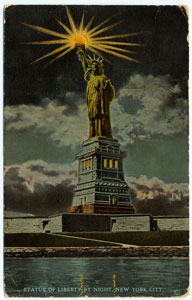
When he died, friends formed a commemorative committee to erect a statue in his honor. This statue was sculpted by John Quincy Ward, and placed on a base designed by Richard Morris Hunt. Among Hunt’s many accomplishments, which include founding the American Institute of Architects (AIA), he also designed the base for the Statue of Liberty, as well as the façade and Great Hall of the Metropolitan Museum of Art.

Statue of Liberty by night, Ne... Digital ID: 836991. New York Public Library
Lady Liberty. Postcard: NYPL Digital Collection
Hunt’s base for the Dodge monument featured a water fountain and small lion’s head, a nod to Dodge’s commitment to temperance. Literature buffs too, will also recognize the inherent symbolism in the lion’s head - commonly used to suggest stateliness, leadership, and reverence.

Pedestrian view of the Dodge monument, 1914. Photo: NYC Transit Museum

Dedicated on October 22, 1885, the statue presided there, in the company of the Herald Building, until Herald Square was refurbished in 1940.

One year later, in 1941, Dodge was moved to the Northeast corner of Bryant Park, and placed on a granite pedestal. The original Hunt pedestal was removed from Herald Square; its current whereabouts are unknown.

Partial view of a 1939 architectural plan detailing the granite pedestal for the Dodge statue once moved to Bryant Park. Map: NYC Parks Department

Dodge remained in the northeast corner of the park, in close proximity to another publisher and philanthropist, William Cullen Bryant, until the 1992 renovation of the park.

Profile view of Dodge on the upper terrace in Bryant Park, 1983. Note the absence of the Bryant Park Cafe. Photo: Bryant Park Corporation / 34th Street Partnership

Rear view of Dodge on the upper terrace, nine years before his (and the park's) restoration. Photo: Bryant Park Corporation / 34th Street partnership

At that point, Dodge underwent a $23,000 renovation, and was moved again in the park to his present location, along the 42nd Street allée, where the Bryant Park Reading Room is located during the warmer months, and currently, the Holiday Shops.


Thursday, September 23, 2010

Washington Irving in Bryant Park

This post also appears on the Bryant Park blog.  

Currently, the Bryant Park grounds are home to several monuments that pay homage to artists, writers, and leaders. Some, such as the statue memorializing William Earle Dodge in the Reading Room, originally stood in other parks and courtyards throughout the city before making their way to Bryant Park. (Dodge’s original home was Herald Square.) Others, such as a bust of American author Washington Irving, resided first in the park, and have since been moved elsewhere.

My interest was first piqued when I found (and bought) this postcard at the Brooklyn Flea. In case you can't read the back, it says "Same old story" and nothing else. A perfect non sequitur circa 1914.

front

back


In the late 1800s to early 1900s, a large bronze bust of Washington Irving, mounted on a granite pedestal, stood in the south side of Bryant Park. The author of “Sleepy Hollow” and many other works, Irving was one of the first American writers to gain international acclaim. 


The statue was donated to the City of New York in 1885 by Joseph Weiner, a German physician and admirer of Irving’s. Sculpted by artist Friedrich Beers, the bust was originally intended for placement in Central Park. Upon completion some members of the NYC Art Committee declared it a success, while others insisted that it wasn’t flattering enough to Irving. The Commission decided to put the bust in Bryant Park, because Irving had served on the park’s advisory council at one point.


It remained in the park for many years, and possibly up until the 1934 renovation. Some say that the statue was moved before that, lost, and then later recovered in a storage shed under the Williamsburg Bridge.

In 1935, the Irving bust was moved to Washington Irving High School (go bulldogs!), where it remains today.

Look here for more details on the history of this and many other NYC statues, and of course, here, for more information about NYC parks, including the other Washington Irving bust, located in Brooklyn's Prospect Park.

Thursday, August 26, 2010

Facades to Pedestals


In the middle of midtown shopping and tourist chaos, at 34th Street, where Broadway and 6th Avenue meet, is a small park maintained by one of my employers, the 34th Street Partnership, called Herald Square. This small triangle of land was named after the New York Herald, a daily newspaper established in 1835 by James Gordon Bennett, Sr. (1795-1872). Known primarily for its sensationalistic coverage of crime and scandal, as well as a massive national circulation, the Herald set up its headquarters at the north end of this small green space in 1894, in a two story arcaded building designed by architecture firm McKim, Mead, and White.


postcard from around 1898 showing the Herald building, as well as the Dodge monument

The ornate building featured several bronze owls mounted along the façade as well as statues of Minerva and two bell-ringing blacksmiths, nicknamed “Stuff and Guff” or “Gog and Magog.”

At this time, the James Earle Dodge monument, now in Bryant Park, occupied a stately position in front of the Herald building. More on him later . . .


Minerva on top of the Herald, and later, as part of the James Gordon Bennett monument


In 1918, the Herald moved its offices to 42nd street, and three years later, the statues were removed from the building’s façade. They went into the possession of William Dewart, then proprietor of the New York Sun. Years later, in 1940, when Herald Square underwent a massive renovation, the statues were given to the city on permanent loan and placed in a Milford granite pedestal in Herald Square Park. The pedestal, designed by architect Aymar Emburry II, along with the statues from the Herald building make up a monument to James Gordon Bennett. The dedication ceremony was held on November 19, 1940.


Before and After contrast