Showing posts with label 34th street. Show all posts

Friday, April 13, 2012

Their Last Voyage

This post also appears on Fashion Herald.

Everybody is talking about the Titanic right now, and some are even just learning that yes, it DID actually happen.

One of three sister ships -- the other two being the RMS Olympic, (launched in 1910) and the RMS Britannic (launched in 1914) -- the Titanic was the largest passenger ship afloat. At the time of its maiden voyage from Southhampton England to New York City, US on April 10,1912, the RMS Titanic was guaranteed unsinkable.
Titanic launching from Southhampton. Photo: National Geographic
A few days later the ship collided with an iceberg, and on April 15 sank, taking with it 1,517 passengers and crew members. Among those were co-owner of Macy's department stores Isidor Straus, and his wife Ida, as well as John Jacob Astor IV and his pregnant (and much younger) wife Madeleine Talmadge Force Astor.

The "Macy's corner" at 34th Street and Broadway, [1910-1915]. By this time the store and neighborhood were bustling with activity.
When offered a spot in one of the ship's few lifeboats, Ida Straus said something to the effect of this: "We have lived together for many years. Where you go, I go." Or maybe this: “I have lived with him for 50 years - I won’t leave him now." She stayed on board with her husband and they perished together. After their deaths, her fidelity and loyalty were celebrated in the press, as well as with several memorials and positive portrayals in plays, music, and movies. (Ha! You thought I was going to link to the James Cameron movie but I didn't!) Below is one of several piano pieces composed in 1912:

Isador and Ida Straus rendered on this commemorative piano piece from 1912. Image: NYPL
Macy's had a plaque made, dedicated, and placed in the store's entrance on 34th Street, just west of Broadway in 1913. Also, three years to the day after the ship sank, a monument was dedicated to the Strauses at Broadway and 106th Street near their former home in New York City, in a small park named after them one year earlier.  It's still there.

The Straus Memorial on its dedication day, April 15, 1915. Photo: Library of Congress

The Straus Memorial on its dedication day, April 15, 1915. Photo: Library of Congress
Designed by Augustus Lukeman, the monument's female figure was created in the likeness of statue model Audrey Munson, also known as "Miss Manhattan," and who deserves her own blog post, maybe with Evelyn Nesbit. (They're classier Lindsay Lohans of the early 1900s, except with possibly more affairs and less cocaine -- or maybe not!)

Audrey Munson with Buzzer the cat. Photo: Library of Congress
This year marks the 100th anniversary of the crash, and the tributes and books are still coming. The National Geographic has never-before seen photos of the shipwreck taken during a 2010 expedition to the wreckage site.
Bad screen shot from this Before and After slideshow. This image shows the Straus suite.
 Other sources:
-Titanic Historical Society
-Titanic Facts
-National Geographic has never-before seen photos of the wreckage. They are stunning.
-Isador Straus obituary.
-Straus Historical Society in Smithtown, New York 
- A nice little Macy's history slide show called Macy's Milestones and the very long, very detailed wikipedia entry on the department store.
-Macy's history on the department store's website
-New York Times

Wednesday, August 31, 2011

A Relic of Early Modernism in Midtown Manhattan

This post also appears on Fashion Herald.

Recently, I went shopping with co-worker and 34th Street fashion guru Tricia, and she noticed the new Steve Madden store, along with a few guys talking in front of it who did not look like tourists, casual passersby, or purchasers of the 5-inch heels Madden is known for. (That last one is an unfair assumption. I have for sure seen many a gent rock a heel way better than I can in this city.) We accosted them, and after explaining what we do for the district, found out that one was the architect for the store. He dragged us into the street saying that we were right this minute across from one of the most beautiful buildings in the city. This one -- 22 West 34th Street.

Photo: A. Kumer, 34SP
I had noticed the building before, but never thought much past why is there would so much wall and so little window. Also, it's backed up against the Empire State Building on 34th Street, so it isn't as if there's nothing else to look at around there. He had such a glow in his eyes as he described the unusual modernness of this design for the time it was built, that I can only imagine he sees it like this instead.

Photo: NYPL digital collection

Designed by architecture firm De Young, Moscowitz & Rosenberg, and built in 1934, it's known in my trusty AIA Guide to New York City, and the above photo, as the Spear & Company building. Originally established in Pittsburgh in 1843, Spear's was a furniture store known for selling knockoffs of modern-style pieces. In addition to a whole lot of facade wall, the building was equipped with air conditioning, indirect lighting, and an auditorium, and cost about $300,000 to build.

In a 1938 New Yorker Skyline column, Lewis Mumford (also cited in Christopher Gray's 1995 Streetscape column) accused the building's designers of practicing fake functional with that small bank of windows facing east, and covered by the Spear's sign, which was yellow neon on a blue background.

By the early 1990s, many of the windows were painted over, Spears was long gone, and signage on the building looked like this:

Photo: N. Mintz, 34SP


A few years later, and a lot of work on behalf of the 34th Street Partnership, the wall sign is gone, though there is still a remnant of a vertical sign and masked windows.

Photo: 34SP
Now thankfully, (scroll all the way up for a refresher), the windows are unobstructed by vertical signage and paint. Mumford would be at least a bit more pleased.

Additional citation:
The Architectural Guidebook to New York City, by Francis Morrone and James Isla, p. 140

Monday, March 28, 2011

The Farley Post Office Building

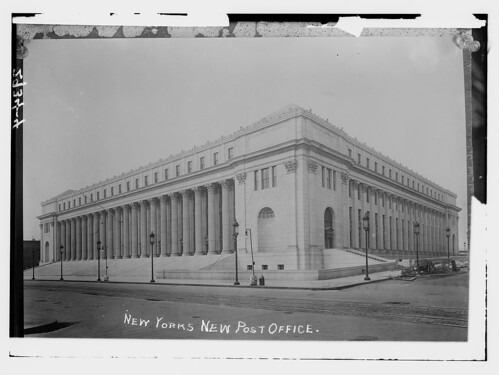
The Farley General Post Office Building is located on the "superblock" between Eighth and Ninth Avenues, and 31st and 33rd Streets, within the 34th Street district in Manhattan.

N.Y.'s new Post Office (LOC)


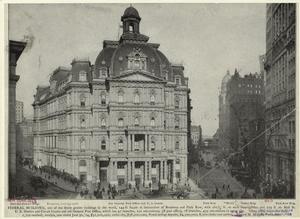
It's massive, old, and almost looks out of place among the surrounding office buildings. A relic from a different time, its closest neighbor is Madison Square Garden. The Farley building was conceived and constructed to replace the 1878 General Post Office, located downtown on Park Row and Broadway.

Old General Post Office and U.... Digital ID: 809382. New York Public Library

Construction of the Pennsylvania Terminal Building, as it was called then, came on the heels of the completion of McKim, Mead & White's monumental Pennsylvania Station. In the photo below, taken in 1913, Penn Station sits in the foreground, with the Penn Terminal building just behind it, to the west, and, for a good measure of bizarre, a lone guy on the roof of the building in the lower right corner. He was probably counting Penn Terminal's colonnade of 20 Corinthian columns, designed to complement the facade of Penn Station. Both buildings were designed and built by McKim, Mead &White, Beaux-Arts kings in the early 1900s.

Photo: MCNY

Penn Station was completed in 1910, and that same year, ground was broken for the Penn Terminal building. Penn Terminal was finished in 1913, and opened for business in September, 1914. In this postcard, most likely issued shortly after the new post office opened, it's rendered quite majestically. The artist took some liberties with the gold-embellished columns, but it really was (and is) an impressive building.

Image: Pisark's Cards
In 1914, Ira Schnapp, who at the time was designing stamps for the Postal Department, was hired as a stone carver by the US Post Office Department to design, and hand-carve the famous quote on the building's front facade:

NEITHER SNOW NOR RAIN NOR HEAT NOR GLOOM OF NIGHT STAYS THESE COURIERS FROM THEIR APPOINTED ROUNDS

The quote comes from Herodotus' Histories 8.98, and refers to Angarum, the royal riding post in the Persian Empire. Schnapp had previous experience carving, having completed the front facade of the New York Public Library in 1911 when he was just 19 years old.

Around 1918, Penn Terminal was renamed General Post Office Building, and here it is in 1920.


Photo: NYPL Digital

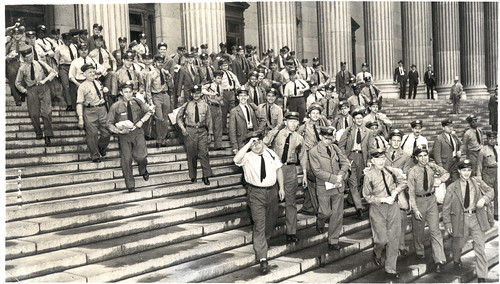
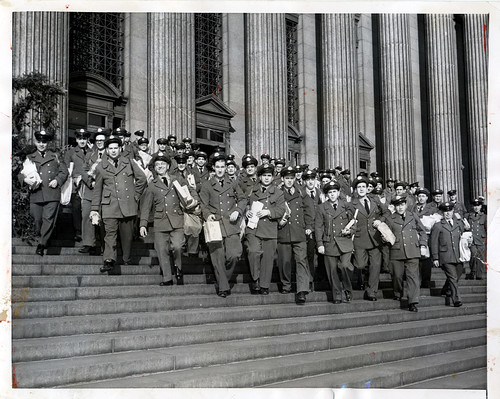
In 1933, President Franklin Delano Roosevelt appointed James A. Farley as the 53rd Postmaster General. Under Farley's leadership, a western annex was added onto the existing building in 1934, and The General Post Office building was extended all the way to Ninth Avenue, giving it superblock status. Farley served until 1940, successfully managing the postal service during the Great Depression, and greatly improving trans-continental mailing services.The next two photos are from the Smithsonian's flikr page, which is definitely worth a visit.

In this photo, taken on June 15, 1936, postmen exit the building to deliver the first round of  WWI "bonus army" checks. In 1932, WWI veterans demonstrated in Washington DC, demanding faster payment for their Service Certificate Payment. Click through the photo for more information.

Carriers Setting Out on Their Daily Rounds


Below, postmen storm the Eighth Avenue steps to deliver holiday packages in 1952, fourteen years before the building was designated a New York City landmark in 1966, and ten years before demolition began on its neighbor Penn Station in 1962 to make way for Madison Square Garden.


Letter Carriers in New York City
Smithsonian flikr

You can still see a good bit of Farley history in the Farley Museum, located in the north pavilion, as well as the building itself. I was fortunate enough to get a brief work-related tour of part of the building. Here are a few photos.

Detailed ceilings in the front foyer


Postal delivery bike on display


Carrier pigeon service, and pigeon capsules(!) in the museum 

  Filigree staircase


 Steel girders in the loading dock (probably original)


<
To read a more in-depth post about the history of the building, check out   Daytonian in Manhattan, and for a more thorough look at the inside of the building as it is now, before it turns into the new Moynihan Station,  check out  Scouting NY.

Friday, November 19, 2010

NYC Monuments: William Earle Dodge


This post also appears on the Bryant Park blog.

Sometimes it seems as if New York’s monuments and statues move about the city's boroughs as much as its citizens do. Often, they will be relocated from one public space to another, because of construction, the whims of city officials, or convenience. The stories of monument preservation, placement, and movement from one park or square to another provide insight to the nature of the public places where they stand.

One in particular, William Earle Dodge, who currently resides midway through Bryant Park's 42nd Street allée, was first dedicated in Herald Square Park, located within one of our sister business improvement districts, the 34th Street Partnership.


Overhead view of Herald Square, showing the Dodge monument, Herald building, and 6th Avenue elevated train, c. late 1930s. Photo: NYC Parks Department

William Earle Dodge was best known as a founder of the successful copper and metals company Phelps Dodge & Co. He also helped start the Young Men's Christian Association (YMCA), and staunchly supported the Prohibition Movement. He served as President of the National Temperance Society from 1865 to 1883, and was instrumental in the publication of over 2,000 supporting books, pamphlets, and posters.


Pedestrian view showing the Dodge monument in Herald Square, c. late 1800s. Postcard: Bryant Park Corporation / 34th Street Partnership

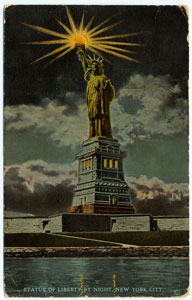
When he died, friends formed a commemorative committee to erect a statue in his honor. This statue was sculpted by John Quincy Ward, and placed on a base designed by Richard Morris Hunt. Among Hunt’s many accomplishments, which include founding the American Institute of Architects (AIA), he also designed the base for the Statue of Liberty, as well as the façade and Great Hall of the Metropolitan Museum of Art.

Statue of Liberty by night, Ne... Digital ID: 836991. New York Public Library
Lady Liberty. Postcard: NYPL Digital Collection
Hunt’s base for the Dodge monument featured a water fountain and small lion’s head, a nod to Dodge’s commitment to temperance. Literature buffs too, will also recognize the inherent symbolism in the lion’s head - commonly used to suggest stateliness, leadership, and reverence.

Pedestrian view of the Dodge monument, 1914. Photo: NYC Transit Museum

Dedicated on October 22, 1885, the statue presided there, in the company of the Herald Building, until Herald Square was refurbished in 1940.

One year later, in 1941, Dodge was moved to the Northeast corner of Bryant Park, and placed on a granite pedestal. The original Hunt pedestal was removed from Herald Square; its current whereabouts are unknown.

Partial view of a 1939 architectural plan detailing the granite pedestal for the Dodge statue once moved to Bryant Park. Map: NYC Parks Department

Dodge remained in the northeast corner of the park, in close proximity to another publisher and philanthropist, William Cullen Bryant, until the 1992 renovation of the park.

Profile view of Dodge on the upper terrace in Bryant Park, 1983. Note the absence of the Bryant Park Cafe. Photo: Bryant Park Corporation / 34th Street Partnership

Rear view of Dodge on the upper terrace, nine years before his (and the park's) restoration. Photo: Bryant Park Corporation / 34th Street partnership

At that point, Dodge underwent a $23,000 renovation, and was moved again in the park to his present location, along the 42nd Street allée, where the Bryant Park Reading Room is located during the warmer months, and currently, the Holiday Shops.


Thursday, August 26, 2010

Facades to Pedestals


In the middle of midtown shopping and tourist chaos, at 34th Street, where Broadway and 6th Avenue meet, is a small park maintained by one of my employers, the 34th Street Partnership, called Herald Square. This small triangle of land was named after the New York Herald, a daily newspaper established in 1835 by James Gordon Bennett, Sr. (1795-1872). Known primarily for its sensationalistic coverage of crime and scandal, as well as a massive national circulation, the Herald set up its headquarters at the north end of this small green space in 1894, in a two story arcaded building designed by architecture firm McKim, Mead, and White.


postcard from around 1898 showing the Herald building, as well as the Dodge monument

The ornate building featured several bronze owls mounted along the façade as well as statues of Minerva and two bell-ringing blacksmiths, nicknamed “Stuff and Guff” or “Gog and Magog.”

At this time, the James Earle Dodge monument, now in Bryant Park, occupied a stately position in front of the Herald building. More on him later . . .


Minerva on top of the Herald, and later, as part of the James Gordon Bennett monument


In 1918, the Herald moved its offices to 42nd street, and three years later, the statues were removed from the building’s façade. They went into the possession of William Dewart, then proprietor of the New York Sun. Years later, in 1940, when Herald Square underwent a massive renovation, the statues were given to the city on permanent loan and placed in a Milford granite pedestal in Herald Square Park. The pedestal, designed by architect Aymar Emburry II, along with the statues from the Herald building make up a monument to James Gordon Bennett. The dedication ceremony was held on November 19, 1940.


Before and After contrast