Showing posts with label Retail History. Show all posts

Tuesday, July 9, 2013

Knox the Hatter

Hats and fascinators seem to be making a comeback, and not just for specific occasions. In 1800s New York, hatters and milliners were all over the place, and it remained a reliable trade until at least the 1960s-ish? President Kennedy stopped wearing hats around then, and so did everyone else, though I'm sure there were other influences.

The Knox Hat Company was founded in 1838 by Charles Knox, a few years after a major fire wiped out most of lower Manhattan. The first store was located on Fulton Street, a couple blocks away from Barnum's American Museum, which was destroyed by another major fire in 1865. Though the store remained intact, looters managed to lift a good portion of the stock (mostly Panama hats) during the fire's aftermath. The Hatter moved again, this time to 212 Broadway, next door to the National Park Bank. 
Knox Hatters at 216 Broadway in Lower Manhattan, 1895. Image: MCNY
Seeing retail make its move north, the Knox Hat Company set its sites on the SW corner of 40th Street and Fifth Avenue for the store's next location.

The SW corner of 40th Street and Fifth Avenue. Before the Knox building, it was occupied by the mansion of Lawrence Kipp, who died in 1899. Image: NYHS
The Knox Building was designed by City Architect John H. Duncan, whose work included Grant's Tomb in Manhattan. The stunning Beaux-Arts commercial building was built in 1901-1902.

From the LPC Report: "Knox retained ownership of the Knox Building until his death. In 1903 he had split the company into the Knox Manufacturing Company and the E.M. Knox Hat Retail Company. Offices for the company and main retail store were located in the building."

SW corner of 40th Street and Fifth Avenue, looking west on 40th Street, c. 1914. Image: NYHS

New construction was growing larger, taller, and more commercial throughout the early 1900s as retail moved north, and the city's  trains and trolleys brought increasing numbers of people into Manhattan for work and play.

In 1913, the Knox Hat Manufacturing Company was amalgamated with the E.M. Knox Retail Hat Company. The company Manufacturing building in Crown Heights, Brooklyn, still exists, though it's now residential.

Knox Hattery advertisement, 1913. Image: NYPL
Pre and post Empire State Building:

Same corner, looking south on Fifth Avenue, 1928 Image: MCNY
NYPL Fifth Avenue terrace, facing south towards 40th Street. Photo by Mike Roberts, 1960. Image: MCNY
The "Jaguar," popular throughout the 1950s and 1960s.


In 1964, the Republic National Bank, then owners of the building, modified it to suit banking purposes (see LPC report for specifics, page 4), and in 1980, began construction of a neighboring tower.  (That bank was bought by HSBC in 1999.)

SW corner of 40th Street and Fifth Avenue, c. 1980. Image: BPC

The tower was completed in 1984 and the pair sort of give the impression of Sense and Sensibility meets Bonfire of the Vanities, architecturally speaking. . . .

SW corner of 40th and Fifth Avenue, 2013. Image: BPC, AK

Knox hats are still coveted by many on the interwebs, with many vintage men's and women's styles for sale on Ebay and Etsy.

Other Sources:
-Landmarks Designation Report, LP-1091
-NYT article on the development of 40th Street in the early 1900s.

Tuesday, June 25, 2013

Woolworth's on Fifth Avenue

Eleven years after B. Altman opened store at 34th and Fifth, the Woolworth's Board of Directors announced that the company would build a large store at the NE corner of 40th Street and Fifth Avenue. The new "Five and Ten Cent Store deluxe" Woolworth's opened in the Fall of 1917.

Parade route along Fifth Avenue -- most likely a WWI send-off parade. The parade is heading south; the view looking north. The Woolworth's store is on the far right, and brownstones where the future Arnold Constable building are to its right (north). Date, ca. 1917  Image: NYPL

Over ten years later, in 1930, the first supermarket was built in Jamaica, New York, making it possible for food shoppers to obtain most, if not all, of their groceries under one roof. That, along with the growth of the suburbs throughout the 1930s, popularized discount retailing. Discount retailers, such as Woolworth's, and in the 1950s, Korvette's and McCreery's, offered frequent sales, less individualized customer service, and savvy merchandising to attract a wide range of customers.

Window shopping on Fifth Avenue, ca. 1930. Image: MCNY
Throughout the 1930s, Woolworth's continued to grow and expand operations throughout the U.S. and in Canada. In 1937, the NYT announced that plans were filed to build the company's 1,000th store at 39th Street and Fifth Avenue, just one block south of the existing flagship store, and next door to the Arnold & Constable Co. store. It opened a year later, in 1938, sixty years after the the first  "Woolworth's Great Five Cent Store" was opened in in Utica, New York. 
Fifth Avenue looking north from 39th Street, ca. late 1930s / early 1940s. Image: Pisark
The new Woolworth's store was designed by architects Starrett & van Vleck, known for designing the flagships of several other department stores, including Lord & Taylor, on Fifth Avenue between 38th and 39th Streets (It's still there.).

Woolworth's shopper shot by Stanley Kubrick, 1947. Image: MCNY

Before Woolworth's the NE corner of 39th Street and Fifth Avenue was home to the Union League Clubhouse. The Union League Club was founded on February 6, 1863, and incorporated on February 16, 1865 as a group of political elites in support of the Union. Among others, Bryant Park's namesake William Cullen Bryant was a member.

Union League Clubhouse, c. 1909, at the NE corner of 39th Street and Fifth Avenue. Image: LOC

The building at 39th Street and Fifth Avenue was the club's third location, having moved first from 17th Street to Madison Avenue and 26th Street. The club moved to 39th Street on March 5, 1881 and stayed until 1931, at which time it moved to it's present location at 37th Street and Park Avenue.

View of 39th Street and Fifth Avenue, showing the Union League Clubhouse and Arnold Constable & Co. store, 1929. Image: MCNY

The F.W. Woolworth Company went defunct in 1997, and as of 2001 the company has been part of Foot Locker Inc.

There are two Foot Locker stores in the 34th Street area, each within blocks of the former Woolworth's store at 35th Street and Broadway.

Woolworth's at 35th Street and Broadway, c. 1927 Image: Pisark

Other Sources
Union League Club Landmarks Preservation Commission Report, LP-2389
This book.
Wikipedia

Thursday, May 23, 2013

Arnold Constable & Company: The Best Mansard in NYC

Just south of the Flatiron building, on East Nineteenth Street, between Broadway and Fifth Avenue, sits the  Arnold Constable Company building. It has one of the largest and most impressive mansards in the city. I can't think of another that is this palatial. It also looks to be two high-ceiling-ed stories tall. I'm awed in ways I can't explain.
Arnold Constable & Co. building, Broadway facade, April 2013. Photo: Anne Kumer
The company was originally founded in 1825 as a small dry goods store in lower Manhattan. In 1857 the founders built a five-story white marble store on Canal and Mercer Streets, a bit north. Because of the store's success, the need to expand again came in less than ten years. In 1869, the company moved farther north, this time to a cast-iron building on Broadway and Nineteenth Street. Designed by Griffith Thomas, the Broadway facade was constructed of white marble. One of the store's founders,  Aaron Arnold felt it was ". . . the only material elegant enough for a prosperous emporium." The AC & Co. was definitely that -- it catered to the carriage trade before the term even came into being, and is credited as being the city's first department store. Arnold died a year before the store's expansion along Nineteenth Street, straight to Fifth Avenue in 1876.

It looked (and looks) something like this:

The Arnold Constable & Co. building showing the Fifth Avenue facade looking east, 1877. Image: archiseek

In 1914, the NYT reported another move uptown to an undisclosed location. That location turned out to be the corner of West 40th Street and Fifth Avenue, directly across from the main NYPL building (built in 1911), near Bryant Park, and just one block south of this. The company traded in its cast iron and mansard glory for a much less decorative structure. French Second Empire be damned.

After the move to West 40th and Fifth Avenue, 1915. Image: MCNY
Around 1925, the store became part of A.T. Stewart Company -- a name in retail history that you can't swing a dead cat without encountering a million times -- and in the late 1930s, several branches of the store were built by then president, Isaac Liberman. In 1975 was forced to close its doors, 150 years after they originally opened in 1825.

This location is now the home of the NYPL Mid-Manhattan branch, but might not be for too long, though this could delay the progress some. The Mansard-ed up Broadway building is still home to a large retailer though: ABC Carpet & Home.

Other Sources:
Ladies' Mile Historic District designation report
Hendrickson, Robert. The Grand Emporiums, p. 154-155

Monday, May 6, 2013

Saks and Gimbels on Sixth

This post also appears on Fashion Herald.

A few years before the ground broke for Penn Station, construction was underway in Herald Square for a retailer new to the city: Saks. The company, founded by Baltimore merchant Andrew Saks, chose Herald Square as the location for its first New York store in part, because of its proximity to the Sixth Avenue elevated train and rumored Penn Station. Along with Macy's and a little later, Gimbels, these major stores would soon redefine Herald Square as a retail hub of the city.

View from Greeley Square, looking north at Herald Square, around 34th Street and Broadway, 1901. Image: MCNY

The Saks building, designed by architecture firm Buchman & Fox, the same firm that would later design the World's Tower building on West 40th Street. Though Saks and Macy's were more or less neck and neck with their store construction and opening announcements, Saks still managed to open its doors just five weeks before Macy's in 1902. Unlike Macy's, a store composed of several departments, Saks in the early 1900s sold only clothing, making it not quite a true department store. Around the same time, one avenue over, Benjamin Altman was purchasing lots on Fifth and 34th to build his new store B. Altman & Co.

The completed Saks building at West 33rd Street with its competitor Macy's one block north at West 34th Street, 1902. Image: MCNY
Those two coexisted, offering consumers slightly different inventories -- Saks was an upscale clothing-based retailer, and Macy's catered to the general consumer with a large variety of merchandise-- until 1909, when another large retailer, Gimbels, joined the fray. Founded by Adam Gimbel in Vincennes, Indiana, Gimbels built its first large store in Philadelphia, PA, before constructing a New York branch just one block south of the Saks store, on Sixth Avenue between 32nd and 33rd Streets. Three large department stores in a row + public transportation = retail district.

Gimbels store at Sixth Avenue, between 32nd and 33rd Streets, 1912, thirteen years before the Gimbels Traverse was built. Image: MCNY

Model wearing a Gimbels dress, 1914. Image: LOC

Similar to Macy's, Gimbels was a large department store and family business.  Adam Gimbel had several sons, many of whom worked for the Gimbels Company: Isaac Gimbel became President in 1894, and was the driving force behind the store's expansion to the New York market; that same year, Ellis Gimbel took over Public Relations and advertising for the company. In 1921, he started the first Thanksgiving Parade in Philadelphia, PA, three years before Macy's began its iconic parade in New York City.

The company purchased Saks in 1923, and one year later, created the Saks Fifth Avenue brand, and opened its first store. The 34th Street location was kept open, and the Saks 34th brand was created. High end retail was moving farther north along Fifth Avenue, and the building's out-of-date construction (it didn't have escalators) were key factors in the decision to close the store in 1965.

Looking north from Greeley Square with the Gimbels and Saks buildings on the left, [1965]. Postcard: Anne

In 1967, discount retailer Korvette's moved into the Saks building. They "modernized" the facade, as seen below. Founded in 1947 by Eugene Ferkauf in a small store on Fifth Avenue and West 47th Street, Korvette's expanded quickly, with 2,684 stores in operation by the mid-1960s. This decade also saw a general rise in the national presence of discount retailers.

Same view as above, [1969]. Postcard: Anne
Gimbels stayed open until 1986. When it finally closed, it was cited as the store with the largest shoplifting rate of any in the country, largely because of the Gimbels Corridor. Originally built as a convenience to shoppers, the underground passageway connected the store to Penn Station a couple blocks away, and provided shoplifters with an easy escape. By the 1970s, the corridor had a horrible reputation and was the scene of more than a few gruesome crimes. This very opinionated description from a NY Post  article (are there any other kinds of NY Post articles?) pretty much sums it up: "In the midst of teeming Midtown, bare-bulb fixtures like those in mines marked a path through a Calcutta-like sprawl of diseased, predatory humanity."

After Gimbels closed, the building was renovated, and in 1989, reopened as A&S Plaza, and is now the home of JC Penney and the Manhattan Mall. Next door, the Saks building, now the Herald Center Mall, is slated for yet another makeover.


Friday, February 3, 2012

Big Retail Comes and Goes with Stern's

The photo below is one of the earliest I have on file of Bryant Park, and maybe one of the most interesting. It shows West 42nd Street between Fifth and Sixth Avenues, about where the W.R. Grace building is now, and a zillion benches lining paths inside the park. All of those buildings have been razed and replaced, and in many cases, their replacements replaced. It was taken in 1912, one year before the Stern brothers built a large flagship store in about the same place on the block.

Photo: BPC Archive


This postcard, most likely of the park between 1913 and 1917 (after Stern's was built, but before the Eagle Hut and Victory Garden), shows the same stretch of West 42nd Street, a pre-Chrysler building skyline, and offers further evidence of park bench enthusiasm.

 Postcard: Pisark's


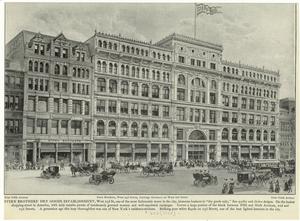
The retailer had been growing steadily for several years by the time Stern's built the 42nd Street flagship store. It was founded in 1867 as the Stern Brothers Department Store in Buffalo, New york. Just one year later, the company operated out of a one room store on Sixth Avenue, As the store grew, they eventually moved from the Sixth Avenue location, and built built a six-story Renaissance Revival building on West 23rd Street in 1879. Here it is in 1899:

Image: NYPL Digital
And again in 1905, after a few renovations and additions:

Stern Brothers’ dry goods esta... Digital ID: 809803. New York Public Library
Image: NYPL Digital
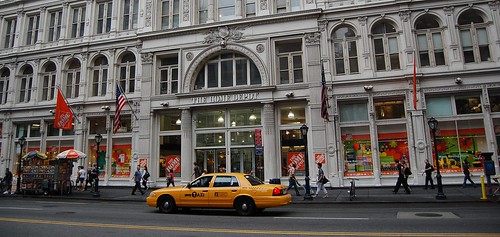
The building still stands, but now houses a Home Depot that only seems to stock house paint, potted plants, and light fixtures. (If you need actual tools or hardware, venture to the outer borough locations.) Still, it's a pleasure to shop in because of natural light afforded by the huge windows and open floor plan.

Stern Brothers
Mattron flickr
In 1913 the company moved from this location to build a new flagship store on West 42nd Street, across from Bryant Park, where it would remain for many years. That building was nine stores tall, with a separate entrance for those wealthy enough to be in the know. The new building was a big enough deal for the Indiana Limestone Company to use it and the neighboring Aeolian building in a 1921 advertisement for their product.

Image: NYPL Digital

As one of the larger department stores in the city, Stern's had a vast inventory of goods. Here are some entertaining bits from the store's directory:

Subway / Basement Level - buying offices, and among other things, something called the Bryant Park Shops
Street Level - impulse buys for women (jewelry, cosmetics) and convenience for men (shoes, suits, etc.), and umbrellas, which have their own department
Street Floor Mezzanine - "surgical aids," cameras
2nd Floor - children's, lingere (These always on the same floor in most large department stores, and usually not too far from linens and bedding -- an entire female existence centered around sex.)
3rd floor -- fashion, fur, leather
4th Floor - domestics - drapes, bedding, and linens
5th Floor - fireplace shop (I know it's relevant for the early 1900s, but in today's context it's hilarious.)

The Department Store Museum has a complete listing, and other useful Stern's info.

By the late 1960s the sales in everything had declined significantly. The flagship store was moved to Bergen Mall in New Jersey, taking with it, West 42nd Street's status as a retail center. The building was sold and torn down to make room for the Grace Building, built by the W.R. Grace Chemical Company, and designed by Gordon Bunshaft of Skidmore, Owings, and Merrill Architects (SOM).

W.R. Grace Building, January 2012. Photo: A. Kumer

Construction started on the Grace building in 1971, and was completed in 1974. It is one of two buildings in the city to have a sloped facade. The other, also designed by Bunshaft is the Solow building. The design of the Grace building is rumored to come from the rejected sketches of the Solow building facade.

Though retail still exists on the ground floor of most of the buildings on this block, I doubt any have a fireplace department.

Other Sources:
Wikipedia
Emporius
To read more about The Stern Brothers' former locations, click here.

Wednesday, November 16, 2011

Finding a Bargain under a Bridge

This post also appears on Fashion Herald.

I LOVE dollar stores, especially Jack's. It's chaotic for sure (I have to be in the mood for an adventure), but there are great deals on a huge variety of merchandise. The first Jack's was opened at 16 East 40th Street, between Fifth and Madison Avenues. In 1994 Jack opened a second store on the first floor of 110 West 32nd Street, between Sixth and Seventh Avenues, and three years later, a closeout retail store called Jack's World, on the 2nd and 3rd floors in the same building. Here is 110 West 32nd Street in 1912 -- it's the middle building with the sexy cornice and Penn Station in the background to the west.

Photo: MCNY
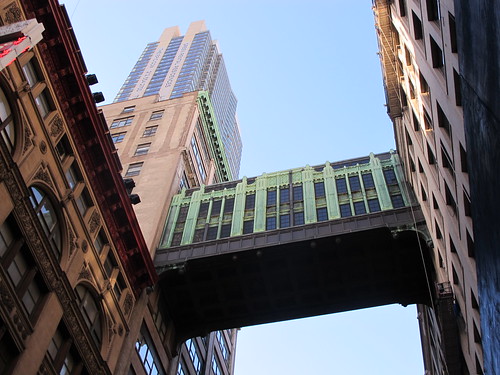
The photo above was taken just after the completion of its neighbor to the west, known then as the Cuyler Building, and later as the Gimbels Administration Building, and even later, as one host to the Gimbels Traverse, or skybridge (more on that later). As for the "Jack's" building -- visible below to the left of the skybridge -- it was probably built in the early 1900s.

Manhattan, West 32nd Street, b/t Sixth Avenue & Seventh


According to  Walter Grutchfield's extremely informative website on New York City wall signs, 14 to 42, the building was occupied by a company called Alliance Press from about 1907 to 1938, and Protective Ventilator Co. from 1910-1916.  In 1916, Willoughby's Camera Stores purchased the building, setting up a much-loved shop on the ground floor. The camera and photography store (one of NYC's oldest) was there until 1994, bringing us full circle to Jack's. Again, 14 to 42 gives a concise history of Willoughby's, so I'm not sure I need to.  I can, via the MCNY photo collection, contribute a Willoughby's window from 1945:

Photo: MCNY

Wednesday, August 31, 2011

A Relic of Early Modernism in Midtown Manhattan

This post also appears on Fashion Herald.

Recently, I went shopping with co-worker and 34th Street fashion guru Tricia, and she noticed the new Steve Madden store, along with a few guys talking in front of it who did not look like tourists, casual passersby, or purchasers of the 5-inch heels Madden is known for. (That last one is an unfair assumption. I have for sure seen many a gent rock a heel way better than I can in this city.) We accosted them, and after explaining what we do for the district, found out that one was the architect for the store. He dragged us into the street saying that we were right this minute across from one of the most beautiful buildings in the city. This one -- 22 West 34th Street.

Photo: A. Kumer, 34SP
I had noticed the building before, but never thought much past why is there would so much wall and so little window. Also, it's backed up against the Empire State Building on 34th Street, so it isn't as if there's nothing else to look at around there. He had such a glow in his eyes as he described the unusual modernness of this design for the time it was built, that I can only imagine he sees it like this instead.

Photo: NYPL digital collection

Designed by architecture firm De Young, Moscowitz & Rosenberg, and built in 1934, it's known in my trusty AIA Guide to New York City, and the above photo, as the Spear & Company building. Originally established in Pittsburgh in 1843, Spear's was a furniture store known for selling knockoffs of modern-style pieces. In addition to a whole lot of facade wall, the building was equipped with air conditioning, indirect lighting, and an auditorium, and cost about $300,000 to build.

In a 1938 New Yorker Skyline column, Lewis Mumford (also cited in Christopher Gray's 1995 Streetscape column) accused the building's designers of practicing fake functional with that small bank of windows facing east, and covered by the Spear's sign, which was yellow neon on a blue background.

By the early 1990s, many of the windows were painted over, Spears was long gone, and signage on the building looked like this:

Photo: N. Mintz, 34SP


A few years later, and a lot of work on behalf of the 34th Street Partnership, the wall sign is gone, though there is still a remnant of a vertical sign and masked windows.

Photo: 34SP
Now thankfully, (scroll all the way up for a refresher), the windows are unobstructed by vertical signage and paint. Mumford would be at least a bit more pleased.

Additional citation:
The Architectural Guidebook to New York City, by Francis Morrone and James Isla, p. 140