Wednesday, October 16, 2013

Whale Fever at 35th and Broadway

One of the more outlandish things in Midtown Manhattan during the 1800s was The New York Aquarium, located at the NW corner of 35th Street and Broadway.


The aquarium was a short-lived, but very ambitious venture, founded by William Cameron Coup and Charles Reiche. Coup was already well-known for his collaborations with P.T. Barnum -- he helped set up and manage P.T. Barnum's Museum, Menagerie and Circus.

 The New York Aquarium opened on October 11, 1876. The building was 20,000 square feet, and included space for exhibition as well as research. The centerpiece of the main pavilion was a 30-foot tank intended to house a whale, or, whales (plural). Additional tanks flanked the whale tank, intended for sea lions and elephant seals, and tanks along the pavilion's north and east walls housed fish.

Image: MCNY


In his memoir Sawdust and Spangles, Coup devotes a chapter to the Aquarium and it's specimens. It sort of reads like a manual on how not to transport aquatic animals from distant places. Even so, his enthusiasm and love for the creatures comes through. He starts with a description of a rare species of Japanese fish that has three tails (it's a goldfish), and continues with a description of whale transport  that involved a days-long journey by boat from the Norwegian coastline to Canada, then a 90-hour train ride from Canada to New York City. Three died en route on separate journeys before one was delivered alive and transferred to the aquarium on October 15, 1876, a few days after the aquarium's official opening.

The whale exhibited -- briefly, before it too died -- was most likely a beluga whale. 

White Whale, drawing, c. 1820: source

The year 1870 brought the aquarium's first sea lions, another main attraction. Pinnipeds have been exhibited in captivity since around the 1600s, but this exhibit was likely one of New York's first. The pinniped pen was located next to the whale tank, and drew guests from all over.

In 1879 Coup and Reiche disagreed on the practice of opening the business on Sundays --  Reiche was for it, and Coup against. Reiche bought out Coup's share of the company and went on to pursue other enterprises.

The aquarium closed in 1881, and the NW corner of 35th and Broadway soon became known for its theater venues, first as the location for the New Park Theater in 1883, and from 1894 until 1914, the home of the Herald Square Theater.

Tuesday, October 8, 2013

Halloween Costume Ideas

This Halloween, let's look at history for a little costume inspiration. You could dress up as . . .

An oil drum:

Image via the Kansas History Foundation
   A Rooster, or a Pigeon

Image

Couples idea (!) and possible inspiration for Donnie Darko?

Image
  A Leafy Green

Image
 Or keep it simple with homemade paper bag and plate masks.

Diane Arbus

Friday, October 4, 2013

Chock Full O' Nuts


For many years a Choc Full o' Nuts lunch counter occupied retail space in the ground floor of the Hotel McAlpin, now, Herald Towers building, at 34th and Broadway. Like most restaurants in Midtown Manhattan, it was packed around lunchtime. 

December 1954, Alfred Eisenstaedt. Photo: LIFE via this blog post.
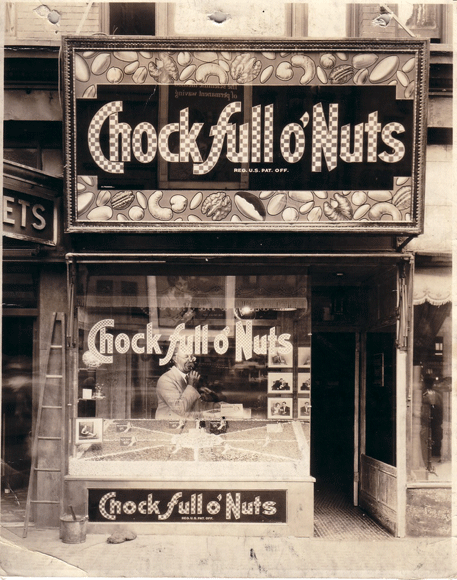
Choc Full o' Nuts opened its first store near Times Square at Broadway and 43rd Street, in 1926. The company continued to grow, opening its first cafe opened in 1932, and following with food trucks.


Possibly the first store, c. 1926 Photo: Pinterest


Food cart from the 1930s or 1940s. Photo: here
The company's founder was William Black, who, as his business grew, also became a well respected philanthropist. He donated a lot of money towards medical research, and in 1957 founded the Parkinson's Disease Foundation with an initial donation of $100,000.

One of Choc's most well known employees was famed baseball player Jackie Robinson. Shortly after retiring from baseball in 1956, he was hired as the company's Vice President and Director of Personnel. Mr. Robinson was an extremely vocal Civil Rights advocate as well. NARA has a great collection of his letters. 

William Black and Jackie Robinson at a store opening. Photo: NYT
The comments section of this post by Ephemeral New York includes many fond memories of the franchise in the city.

For a while, Choc Full o' Nuts at 34th Street and Woolworth's supplied Midtown workers with two solid lunch options flanking Herald Square. The 34th Street lunch counter closed in 1990.

Where do you go to get an Egg Cream now?

Tuesday, September 3, 2013

N. Jay Jaffee

This post also appears on the Bryant Park blog.

It's been over a month since my last post. I'm working on a bunch of small projects that will hopefully wrap up in the coming weeks. In the meantime, here's a short post featuring one of the city's many street photographers.  

These gentleman are leaning up against a fairly marked up William Cullen Bryant monument in Bryant Park. The photo was taken in 1953 by photographer N. Jay Jaffee.

Bryant Park, W.C. Bryant Monument, 1953. Photo by N. Jay Jaffee. Image: Brooklyn Museum
People still sit with Bryant on a daily basis in the park, though, since 1992, they've had chairs.

Jaffee is one of my favorite photographers right now, so here are a few more of his images:

Another park scene, not Bryant Park.

Woman in Black, 1978. Photo by N. Jay Jaffee. Image: Brooklyn Museum
Signage, two ways:

Who Has Three or Four Rooms (Brownsville, NY), 1950. Photo by N.J. Jaffee. Image: Brooklyn Museum


Kishke King, Pitkin Avenue (Brownsville, NY) 1953. Photo by N. Jay Jaffee. Image: Brooklyn Museum


Wednesday, July 24, 2013

Kubrick

A couple of weeks ago, I was going through the MCNY digital archive for this post, and came across the Stanley Kubrick photo collection. It's awesome. I hadn't realized how much street photography he'd done prior to his film work. This image of a Columbia Professor messing with lights, taken in 1948, is especially good.

Image: MCNY

It reminded me of this shot of Peter Sellers in Dr. Strangelove or: How I Learned to Stop Worrying and Love the Bomb (imdb).


There's a 16 year gap between when the image and film were made, but the aesthetic seems on point.

Tuesday, July 9, 2013

Knox the Hatter

Hats and fascinators seem to be making a comeback, and not just for specific occasions. In 1800s New York, hatters and milliners were all over the place, and it remained a reliable trade until at least the 1960s-ish? President Kennedy stopped wearing hats around then, and so did everyone else, though I'm sure there were other influences.

The Knox Hat Company was founded in 1838 by Charles Knox, a few years after a major fire wiped out most of lower Manhattan. The first store was located on Fulton Street, a couple blocks away from Barnum's American Museum, which was destroyed by another major fire in 1865. Though the store remained intact, looters managed to lift a good portion of the stock (mostly Panama hats) during the fire's aftermath. The Hatter moved again, this time to 212 Broadway, next door to the National Park Bank. 
Knox Hatters at 216 Broadway in Lower Manhattan, 1895. Image: MCNY
Seeing retail make its move north, the Knox Hat Company set its sites on the SW corner of 40th Street and Fifth Avenue for the store's next location.

The SW corner of 40th Street and Fifth Avenue. Before the Knox building, it was occupied by the mansion of Lawrence Kipp, who died in 1899. Image: NYHS
The Knox Building was designed by City Architect John H. Duncan, whose work included Grant's Tomb in Manhattan. The stunning Beaux-Arts commercial building was built in 1901-1902.

From the LPC Report: "Knox retained ownership of the Knox Building until his death. In 1903 he had split the company into the Knox Manufacturing Company and the E.M. Knox Hat Retail Company. Offices for the company and main retail store were located in the building."

SW corner of 40th Street and Fifth Avenue, looking west on 40th Street, c. 1914. Image: NYHS

New construction was growing larger, taller, and more commercial throughout the early 1900s as retail moved north, and the city's  trains and trolleys brought increasing numbers of people into Manhattan for work and play.

In 1913, the Knox Hat Manufacturing Company was amalgamated with the E.M. Knox Retail Hat Company. The company Manufacturing building in Crown Heights, Brooklyn, still exists, though it's now residential.

Knox Hattery advertisement, 1913. Image: NYPL
Pre and post Empire State Building:

Same corner, looking south on Fifth Avenue, 1928 Image: MCNY
NYPL Fifth Avenue terrace, facing south towards 40th Street. Photo by Mike Roberts, 1960. Image: MCNY
The "Jaguar," popular throughout the 1950s and 1960s.


In 1964, the Republic National Bank, then owners of the building, modified it to suit banking purposes (see LPC report for specifics, page 4), and in 1980, began construction of a neighboring tower.  (That bank was bought by HSBC in 1999.)

SW corner of 40th Street and Fifth Avenue, c. 1980. Image: BPC

The tower was completed in 1984 and the pair sort of give the impression of Sense and Sensibility meets Bonfire of the Vanities, architecturally speaking. . . .

SW corner of 40th and Fifth Avenue, 2013. Image: BPC, AK

Knox hats are still coveted by many on the interwebs, with many vintage men's and women's styles for sale on Ebay and Etsy.

Other Sources:
-Landmarks Designation Report, LP-1091
-NYT article on the development of 40th Street in the early 1900s.

Tuesday, June 25, 2013

Woolworth's on Fifth Avenue

Eleven years after B. Altman opened store at 34th and Fifth, the Woolworth's Board of Directors announced that the company would build a large store at the NE corner of 40th Street and Fifth Avenue. The new "Five and Ten Cent Store deluxe" Woolworth's opened in the Fall of 1917.

Parade route along Fifth Avenue -- most likely a WWI send-off parade. The parade is heading south; the view looking north. The Woolworth's store is on the far right, and brownstones where the future Arnold Constable building are to its right (north). Date, ca. 1917  Image: NYPL

Over ten years later, in 1930, the first supermarket was built in Jamaica, New York, making it possible for food shoppers to obtain most, if not all, of their groceries under one roof. That, along with the growth of the suburbs throughout the 1930s, popularized discount retailing. Discount retailers, such as Woolworth's, and in the 1950s, Korvette's and McCreery's, offered frequent sales, less individualized customer service, and savvy merchandising to attract a wide range of customers.

Window shopping on Fifth Avenue, ca. 1930. Image: MCNY
Throughout the 1930s, Woolworth's continued to grow and expand operations throughout the U.S. and in Canada. In 1937, the NYT announced that plans were filed to build the company's 1,000th store at 39th Street and Fifth Avenue, just one block south of the existing flagship store, and next door to the Arnold & Constable Co. store. It opened a year later, in 1938, sixty years after the the first  "Woolworth's Great Five Cent Store" was opened in in Utica, New York. 
Fifth Avenue looking north from 39th Street, ca. late 1930s / early 1940s. Image: Pisark
The new Woolworth's store was designed by architects Starrett & van Vleck, known for designing the flagships of several other department stores, including Lord & Taylor, on Fifth Avenue between 38th and 39th Streets (It's still there.).

Woolworth's shopper shot by Stanley Kubrick, 1947. Image: MCNY

Before Woolworth's the NE corner of 39th Street and Fifth Avenue was home to the Union League Clubhouse. The Union League Club was founded on February 6, 1863, and incorporated on February 16, 1865 as a group of political elites in support of the Union. Among others, Bryant Park's namesake William Cullen Bryant was a member.

Union League Clubhouse, c. 1909, at the NE corner of 39th Street and Fifth Avenue. Image: LOC

The building at 39th Street and Fifth Avenue was the club's third location, having moved first from 17th Street to Madison Avenue and 26th Street. The club moved to 39th Street on March 5, 1881 and stayed until 1931, at which time it moved to it's present location at 37th Street and Park Avenue.

View of 39th Street and Fifth Avenue, showing the Union League Clubhouse and Arnold Constable & Co. store, 1929. Image: MCNY

The F.W. Woolworth Company went defunct in 1997, and as of 2001 the company has been part of Foot Locker Inc.

There are two Foot Locker stores in the 34th Street area, each within blocks of the former Woolworth's store at 35th Street and Broadway.

Woolworth's at 35th Street and Broadway, c. 1927 Image: Pisark

Other Sources
Union League Club Landmarks Preservation Commission Report, LP-2389
This book.
Wikipedia