Showing posts with label herald square. Show all posts

Friday, October 4, 2013

Chock Full O' Nuts


For many years a Choc Full o' Nuts lunch counter occupied retail space in the ground floor of the Hotel McAlpin, now, Herald Towers building, at 34th and Broadway. Like most restaurants in Midtown Manhattan, it was packed around lunchtime. 

December 1954, Alfred Eisenstaedt. Photo: LIFE via this blog post.
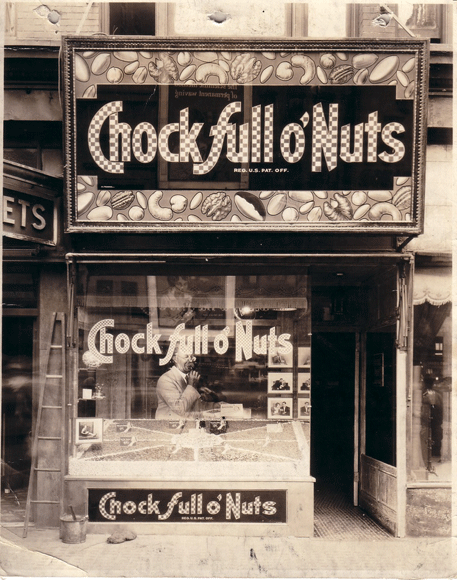
Choc Full o' Nuts opened its first store near Times Square at Broadway and 43rd Street, in 1926. The company continued to grow, opening its first cafe opened in 1932, and following with food trucks.


Possibly the first store, c. 1926 Photo: Pinterest


Food cart from the 1930s or 1940s. Photo: here
The company's founder was William Black, who, as his business grew, also became a well respected philanthropist. He donated a lot of money towards medical research, and in 1957 founded the Parkinson's Disease Foundation with an initial donation of $100,000.

One of Choc's most well known employees was famed baseball player Jackie Robinson. Shortly after retiring from baseball in 1956, he was hired as the company's Vice President and Director of Personnel. Mr. Robinson was an extremely vocal Civil Rights advocate as well. NARA has a great collection of his letters. 

William Black and Jackie Robinson at a store opening. Photo: NYT
The comments section of this post by Ephemeral New York includes many fond memories of the franchise in the city.

For a while, Choc Full o' Nuts at 34th Street and Woolworth's supplied Midtown workers with two solid lunch options flanking Herald Square. The 34th Street lunch counter closed in 1990.

Where do you go to get an Egg Cream now?

Tuesday, March 26, 2013

Bennett's Owls

This post also appears on Fashion Herald.

James Gordon Bennett Jr.'s adoration of owls may have bordered on pathological, but in the best possible way. While serving as a Third Lieutenant for the U.S. Revenue Cutter Service (the pre-Coast Guard Coast Guard) during the Civil War, the son of New York Herald founder James Gordon Bennett Sr. claimed that a serendipitous owl guided him through rough seas to safety.

As a tribute to his spirit animal, he lined the Herald building with several bronze owls in 1894, and years later even had an owl shaped tomb designed to hold his remains. The Herald owls, along with the statue of Minerva and the bell ringers, were created by French sculptor Antonin Jean Carles. The two corner owls with their wings spread had eyes that lit up to the delight of evening passersby.

The Herald building in the early 1900s, looking north from 34th Street. Statuary from the Bennett monument in Herald Square is on the facade of the building along with Bennett's owls.

Today those two owls perch on either side of the Herald monument, and their eyes continue to light the way.
Back of the Herald Square monument, facing south. Photo: 34SP

Two more of Bennet's owls guard the entrance to Herald Square.

Entrance owl. Photo 34SP
The Herald building may have been Bennett's most well known tribute to the bird, but it wasn't his first. At some point in the mid 1800s Bennett bought a stone villa in Newport Rhode Island, originally built in 1833 by Rhode Island stonemason Alexander McGregor. The new homeowner enlisted the help of Newport architect Dudley Newton to add several embellishments to the property, including gateposts topped with owl statuary. It's hard to see in this picture, but these look to be a leaner species than the Herald owls, but no less fierce.

Bennett's stone villa and owl sentries in 1957, shortly before the building was demolished to make way for a shopping center. Photo: Preservation Society of Newport County
So solid was his devotion to the bird, he also had Stanford White design a 200-foot high tomb shaped like an owl that would serve as Bennett's mausoleum. Work was halted due to the untimely but not entirely surprising death of Stanford White in 1906. The design never came to be, but the Times reported that in 1918, shortly after Bennett's death, drawings of a model owl tomb were found on the desk of sculptor Andrew O'Conner, who had been commissioned by White to work on the initial designs.

That same year Frank Munsey, then owner of the New York Sun bought out the Herald, combined the two papers, and moved the offices to 42nd Street. The owls were removed from the facade of the Herald building. A few have since resurfaced: aside from the Herald Square owls mentioned above, the Brooklyn Museum has a couple on display, and there are a few above the entrance to NYU's Shimkin Hall.

Tuesday, November 13, 2012

The Herald Building: Now with a Duane Reade!


This post also appears on Fashion Herald.

The New York Herald building at West 35th Street where Broadway meets Sixth Avenue, was a two-story building designed by Stanford White of architecture firm McKim, Mead & White. White was commissioned to build it for friend James Gordon Bennett Jr. to house the new Herald offices when the paper moved uptown from Park Row in 1894. The story of the Herald and its founders are here, here, and here.

Photo: MCNY

The Herald had offices in this building until Bennett Jr.’s death in 1918. Soon after, Frank Munsey bought the paper and merged it with the New York Sun to create the Herald-Sun. The new combo-paper’s offices were moved to West 42nd Street. 

The north half of the building was demolished in 1921, leaving only the southern part, statues intact on the  building’s façade. 

Photo: MCNY
Eventually, in 1930, a new, 24-story office building was designed and built by the architecture firm Clinton & Russell where the northern half used to be. The firm was founded in 1894, the same year the Herald building was completed (weird coincidence!).

Photo: Berenice Abbott via the  NYPL and MCNY
In the 1930s the Sixth Avenue Group (a business improvement group of sorts) sponsored a contest to re-design and “beautify” the area following construction of a new underground subway line and station, and the razing of the Sixth Avenue elevated line. The low rise portion of the Herald building was completed in 1940. I’m pretty sure that "completed" meant that the building was stripped of its Stanford White-designed façade work and given the 1940s-1950s simple (sterile) treatment. The front windows are much larger in the new building, and the ground floor looks lower, but I think the building's original bones are still there. That same year, the James Gordon Bennett memorial was installed in Herald Square in the form of a 40 ft. tall monument, unveiled during a dedication ceremony on November 19, 1940. 

Postcard: Pisark's
Herald Square and the surrounding area went into a decline in the 1970s and 1980s, but were brought back to life with a late 1990s renovation by the 34th Street Partnership.The building is still there, and the first two floors are currently home to a massive Duane Reade.Time marches on.

Additional Sources:
Kruger, Richard. The Paper: The Life and Death of the New York Herald Tribune
“Sixth Ave. Group to Beautify Parks,” NYT, March 24, 1939
“Frank A. Munsey Buys the Herald and the Telegram,” NYT, January 15, 1920


Thursday, October 11, 2012

The James Gordon Bennetts' New York Herald, Part 3

This is part 3 of a 3 part series on the New York Herald.

After returning to the States, Bennett commissioned Stanford White to design new offices for the Herald. The new building would be located a fair distance from Park Row and competitor Joseph Pulitzer's World building, completed in 1890. Bennett obtained a 30-year lease at Sixth Avenue and 35th Street, at the south border of a small clearing then known as Dodge Plaza in honor of William Earle Dodge, who I've mentioned before.

Park Row, and most of the competition
Bennett chose the new site for its proximity to public transportation and nightlife. The elevated train line had been built a few years before, and now afforded the public, including Herald's reporters, easy access to most parts of the city. The site also bordered Tin Pan Alley, and several music halls and theaters, including places like Jim Corbett's and the Haymarket.

Corbett's, said to be a hangout spot for JGB Jr., c. 1900. Photo: MCNY
No stranger to scandal himself, Stanford White designed an elaborate Renaissance Revival building based on Fra Giancondo's Loggia del Consiglio, a late 15th century seat of the local city council in Verona.  The Loggia's roof was lined with sculptures of famous poets, including the risque poet Catallus. It is said that this inspiration was chosen on purpose as a nod of sorts to the Herald's coarse nature and Bennett's sporting life.

Instead of poets lining the roof, Bennett chose his spirit animal, the owl. Supposedly he claimed that an owl's cry saved him at sea during his Civil War service.

the Herald building shortly after construction. Postcard: Pisark's
A couple of them are now incorporated in the Bennett memorial in Herald Square. I've written of the monument before, and so have others. . .

Ever-conscious of public perception, Bennett mandated that there would be windows along the Broadway side of the building allowing passersby to view the presses below. People loved it and regularly crowded at them to watch sheet after sheet of the Herald come off the presses.

The Herald building's elaborate western facade and people crowding near the windows, c. 1902 Photo: LOC
And, what they saw below:

The Herald presses, c. 1902. Photo: LOC
The acclaim of the building and increased commerce of the area led to a name change for the Square. It became known as Herald Square in the late 1890s. Still a commercial hub, now instead of newspapers, the square welcomes millions of daily shoppers.

Part 1 can be found here; part 2 here.

More sources:
Broderick, Mosette. Triumvirate, McKim, Mead & White: Art, Architecture, Scandal, and Class in America’s Gilded Age.

Thursday, September 20, 2012

The James Gordon Bennetts' New York Herald, Part 2

This is part 2 of a 3 part series on the New York Herald.

In 1866 James Gordon Bennett Sr. passed the publishing duties of the New York Herald on to a man who many thought to be an unlikely successor -- his son James Gordon Bennett Jr.

Image: NYPL
James Gordon Bennett Jr. is best known in history for his devotion to yachting, ballooning, and socializing on a grand scale. Mostly due to the Herald's commercial success, he was raised to cultivate and enjoy just about any recreational activity that required expensive equipment and/or traveling. Aside from a brief stint serving as a Third Lieutenant for the U.S. Revenue Cutter Service during the Civil War, Bennett practiced a life of leisure with a consistency and fervor that led artist friend and Julius LeBlanc Stewart to paint it at least twice. 

On the Yacht "Namouna", Venice (1890), Julius LeBlanc Stewart
 . . . with totally different lighting schemes. The sky in the painting below looks like the sun is rising and setting at the same time.

Yachting on the Mediterranean (1896), Julius LeBlanc Stewart

As publisher of the Herald JGB Jr. had an extensive list of "Don'ts" for reporters to follow. The list contained very detailed instructions on how to address or refer to the wealthy (i.e. his friends) in text. Father and son were a study in opposites: James Gordon Bennett Sr. was known for exposing scandal, and James Gordon Bennett Jr. was known for living it. Their contradictory lifestyles did not escape other members of the press, who regularly satirized both, and often referred to Jr. as "The Commodore." Here, JGB Sr. visits his namesake from the grave to keep him in line, and Jr. reacts.
Image: NYPL
Under Bennett Jr.'s leadership, the Herald's circulation gradually dropped and expenses steadily rose. Bennett moved to Paris in 1877 (Wikipedia, 4th paragraph) and continued to run the newspaper from there. While in Paris, he launched the Paris Herald (forerunner to the International Herald Tribune), and an evening edition of the paper called the Telegraph. He wasn't gone for good though. The famous Herald building was still yet to be built and the Square named after the paper of the same name. More on this in part 3.

Part 1 of this series can be found here.

Thursday, September 13, 2012

The James Gordon Bennetts' New York Herald, Part 1

This is part 1 of a 3-part series on the New York Herald. All three posts will eventually appear on Fashion Herald, a blog about 34th Street district retail.

One of the fathers of modern journalism, James Gordon Bennett Sr. founded the New York Herald in 1835 in a small office on Wall Street. Bennett vowed that his new penny paper would have none of the political alliances and proselytizing found in other papers.

Cross-eyed, Bennett once wrote that his affliction came from watching the "winding ways of [President] Martin Van Buren." Photo: Library of Congress
Bennett had excellent intuition for what was missing in journalism of his time, and how to appeal to the general population. With an almost prophetic sense of the financial crisis to come in 1837, the Herald was the first general interest paper to pen a financial column. "Money Markets" debuted within a week of the paper's first issue in 1836 and was immensely popular. In it, Bennett exposed stock market fraud and speculated that the rise and fall of the stock market was not accidental.

Bennett also tapped into what have since become public obsessions -- crime, scandal, and celebrities. Lurid descriptions and relentless coverage of these are common today, but in the 1830s, murders and the like were scarcely reported, if at all. The murder of prostitute Ellen Jewett in 1836, and the Herald's subsequent front page coverage of the event and trial changed all of that.

One of many postmortem caricatures of Ms. Jewett. Photo: Library of Congress
The Herald was the first paper to take reporting to that special macabre place by printing detailed descriptions of the courtroom proceedings and crime scene. Bennett was also one of the first editors to publish interviews with key witnesses and others involved in the case, the first being a lengthy interview with Jewett's Madame Rosina Townsend. 

For those who couldn't afford theater or concert tickets, the newspaper turned the news into its own little episodic show -- kind of like one really long Law and Order episode. Each day readers could open the paper to a new spectacle of horrors. Because intimate knowledge of the case was dispelled daily via the paper, devoted readers could consider themselves an active part of the drama.

Bennett spared no expense on technology advances to increase the paper's reporting and production efficiency. During the Mexican-American War, he established a courier service that was faster than the post office in order to get reports from the front lines to the Herald offices in New York City. (It was soon shut down by the postal service.) Bennett secured a steady readership while covering the Civil War by publishing eyewitness accounts of soldiers on the front lines. To evade Secretary of War Edward M. Stanton's censorship ban on the press, Bennett printed war casualty lists. People bought editions of the paper every day in hopes of finding the names of lost loved ones. Like the Jewett trial case, this produced a regularly paying audience addicted to tragedy, though this time is was more personal.

Bennett's coverage of politics was meant to be impartial, and compared with other papers, it mostly was. The April 15, 1865 edition of the Herald shows a strange marriage of the grisly and the political with its Lincoln assassination coverage. Click here to see a large version of the image below. If you enlarge it, the copy theatrically describes Lincoln's murder scene and the ensuing investigation.

Image: Library of Congress
In 1866 Bennett Sr. passed his duties on to his son James Gordon Bennett Jr. who had long been the subject of tabloid-ish reporting in rival papers. More on him in part 2 next week.

Sorry for the lack of links, but most of this was culled from print sources, including these:
-Carlson, Oliver. The Man Who Made News: James Gordon Bennett
-Kluger, Richard. The Paper: The Life and Death of the New York Herald Tribune
-Pray, Isaac Clarke. Memoirs of James Gordon Bennett and His Times (google books)
-Sandburg, Carl. Storm Over the Land: A Profile of the Civil War.
-Seitz, Don C. The James Gordon Bennetts: Father and Son, Proprietors of The New York Herald.

Monday, February 28, 2011

Street Eats and City Crowds -- 100 Years and Counting

This photo was posted on Shorpy's, a historic and vintage photo blog. It shows Herald Square, currently managed and maintained by the 34th Street Partnership, and the surrounding area, in 1908. That's the 6th Avenue elevated train on the right, and in front of the Herald building, the William Earle Dodge monument, now in Bryant Park.

Image from Shorpy's


Although a relatively common view -- I'm pretty sure the photo was taken from the elevated subway station at 33rd Street, in Greeley Square -- what is special about this particular one, is the insane amount of detail and information it conveys. If you click here to see the high resolution photo, you will see much, much more.

This lunch wagon, spotted by a Shorpy's commenter, and re-blogged by Midtown Lunch, was parked on Sixth Avenue, east of the elevated train tracks, or, to their left in the above photo. The commenter, Copyboy, included an excerpt from a letter sent to the New York Times complaining the cart's placement on Sixth Avenue obstructed pedestrian and vehicular traffic from 34th Street, all the way to 42nd Street, on the northwest corner of Bryant park, where it was often seen.


Displayed on top of the facade of the Herald Building, shown in a close-up below, is the James Gordon Bennett Memorial, removed from the building in 1921, and later reinstalled on a Milford pink granite pedestal in the park in 1940. The owls are another story.


And there's this:


Not nearly as many people in the street then, as now, but it looks so much more chaotic. I can identify at least six different types of transportation in use: automobiles, trolley cars, horse-drawn carriages, walking, the elevated train (not in this close-up, but in the main shot), and that strange thing in the pink box that looks like a motorized pedi-cab with the driver in the back, and passengers up front.  I guess bicycles were still too new to be considered a viable form of transporation, rather than a leisure activity. Also, without traffic lanes, and  organized direction, the street looks more like a free-for-all than it likely was. They're probably all heading for the lunch wagons.

Friday, November 19, 2010

NYC Monuments: William Earle Dodge


This post also appears on the Bryant Park blog.

Sometimes it seems as if New York’s monuments and statues move about the city's boroughs as much as its citizens do. Often, they will be relocated from one public space to another, because of construction, the whims of city officials, or convenience. The stories of monument preservation, placement, and movement from one park or square to another provide insight to the nature of the public places where they stand.

One in particular, William Earle Dodge, who currently resides midway through Bryant Park's 42nd Street allée, was first dedicated in Herald Square Park, located within one of our sister business improvement districts, the 34th Street Partnership.


Overhead view of Herald Square, showing the Dodge monument, Herald building, and 6th Avenue elevated train, c. late 1930s. Photo: NYC Parks Department

William Earle Dodge was best known as a founder of the successful copper and metals company Phelps Dodge & Co. He also helped start the Young Men's Christian Association (YMCA), and staunchly supported the Prohibition Movement. He served as President of the National Temperance Society from 1865 to 1883, and was instrumental in the publication of over 2,000 supporting books, pamphlets, and posters.


Pedestrian view showing the Dodge monument in Herald Square, c. late 1800s. Postcard: Bryant Park Corporation / 34th Street Partnership

When he died, friends formed a commemorative committee to erect a statue in his honor. This statue was sculpted by John Quincy Ward, and placed on a base designed by Richard Morris Hunt. Among Hunt’s many accomplishments, which include founding the American Institute of Architects (AIA), he also designed the base for the Statue of Liberty, as well as the façade and Great Hall of the Metropolitan Museum of Art.

Statue of Liberty by night, Ne... Digital ID: 836991. New York Public Library
Lady Liberty. Postcard: NYPL Digital Collection
Hunt’s base for the Dodge monument featured a water fountain and small lion’s head, a nod to Dodge’s commitment to temperance. Literature buffs too, will also recognize the inherent symbolism in the lion’s head - commonly used to suggest stateliness, leadership, and reverence.

Pedestrian view of the Dodge monument, 1914. Photo: NYC Transit Museum

Dedicated on October 22, 1885, the statue presided there, in the company of the Herald Building, until Herald Square was refurbished in 1940.

One year later, in 1941, Dodge was moved to the Northeast corner of Bryant Park, and placed on a granite pedestal. The original Hunt pedestal was removed from Herald Square; its current whereabouts are unknown.

Partial view of a 1939 architectural plan detailing the granite pedestal for the Dodge statue once moved to Bryant Park. Map: NYC Parks Department

Dodge remained in the northeast corner of the park, in close proximity to another publisher and philanthropist, William Cullen Bryant, until the 1992 renovation of the park.

Profile view of Dodge on the upper terrace in Bryant Park, 1983. Note the absence of the Bryant Park Cafe. Photo: Bryant Park Corporation / 34th Street Partnership

Rear view of Dodge on the upper terrace, nine years before his (and the park's) restoration. Photo: Bryant Park Corporation / 34th Street partnership

At that point, Dodge underwent a $23,000 renovation, and was moved again in the park to his present location, along the 42nd Street allée, where the Bryant Park Reading Room is located during the warmer months, and currently, the Holiday Shops.


Thursday, August 26, 2010

Facades to Pedestals


In the middle of midtown shopping and tourist chaos, at 34th Street, where Broadway and 6th Avenue meet, is a small park maintained by one of my employers, the 34th Street Partnership, called Herald Square. This small triangle of land was named after the New York Herald, a daily newspaper established in 1835 by James Gordon Bennett, Sr. (1795-1872). Known primarily for its sensationalistic coverage of crime and scandal, as well as a massive national circulation, the Herald set up its headquarters at the north end of this small green space in 1894, in a two story arcaded building designed by architecture firm McKim, Mead, and White.


postcard from around 1898 showing the Herald building, as well as the Dodge monument

The ornate building featured several bronze owls mounted along the façade as well as statues of Minerva and two bell-ringing blacksmiths, nicknamed “Stuff and Guff” or “Gog and Magog.”

At this time, the James Earle Dodge monument, now in Bryant Park, occupied a stately position in front of the Herald building. More on him later . . .


Minerva on top of the Herald, and later, as part of the James Gordon Bennett monument


In 1918, the Herald moved its offices to 42nd street, and three years later, the statues were removed from the building’s façade. They went into the possession of William Dewart, then proprietor of the New York Sun. Years later, in 1940, when Herald Square underwent a massive renovation, the statues were given to the city on permanent loan and placed in a Milford granite pedestal in Herald Square Park. The pedestal, designed by architect Aymar Emburry II, along with the statues from the Herald building make up a monument to James Gordon Bennett. The dedication ceremony was held on November 19, 1940.


Before and After contrast