Showing posts with label 34th street history. Show all posts

Friday, August 14, 2015

"Gentleman Jim" Corbett's on 33rd Street

This post also appears on Fashion Herald.

James "Gentleman Jim" Corbett was the heavyweight boxing champion in 1892. He won the title in the 21st round of a fight with the (so far) undefeated John L. Sullivan. Boxing was still illegal in most U.S. states in the late 1800s; New York State didn't legalize it until 1896, and it wasn't made an Olympic sport until 1904.
James "Gentleman Jim" Corbett, 1910. Image: LOC
Corbett legitimized the sport for many by bringing grace and style to the ring. This, along with sharp dressing and a rumored college education earned him the nickname "Gentleman Jim." He followed his career in boxing with a successful one in stage acting. Sometime in the late 1800s he opened a cafe on Broadway, just north of 33rd Street, and named it Corbett's.

Corbett's on Broadway and 33rd Street looking north, 1900. Image: MCNY
Corbett's fit in well in the neighborhood, then an area full of restaurants, bars, and smaller theaters. Actors and publishers were known to drop by, and it was conveniently located near the elevated Sixth Avenue train.

34th Street, where Sixth Avenue and Broadway meet, with the Corbett's sign on the left, 1901. Image: NYPL
The turn of the century brought big retail to the area, and many of the buildings in the neighborhood were razed to make way for large department stores. Andrew Saks bought the properties on the corner of 34th Street where Sixth Avenue and Broadway meet, including the Corbett's building. Saks built his 34th Street flagship store on that corner in 1901. Gimbels followed one block south with a store in 1910, and in the late 1930s, the elevated train went underground.

Saks 34th Street, 1955. Image: MCNY
Though the 34th district is populated with plenty of bars and restaurants, retail still dominates the streetscape. 
34th at Broadway, 2015. Image: 34SP, Anne Kumer


Wednesday, February 11, 2015

Liberty Corner

The Broadway Tabernacle Church was formed as a pulpit for the reformist preacher Charles Grandison Finney in the mid-1830s. Finney was an advocate of social reform, primarily equal education for all people regardless of race or gender, as well as a proponent of the growing abolition movement.  The church auditorium was one of the city's largest public halls, and hosted rallies, scientific demonstrations, and lectures, as well as sermons.

In 1842 noted geologist Sir Charles Lyell gave a series of lectures on Uniformitarianism, the then groundbreaking theory that the earth is developed and shaped by slow moving forces still in effect. Two years later, the church hosted the first public demonstration of nitrous oxide used as an anesthetic.

Broadway Tabernacle auditorium at Worth Street and Broadway, 1850. Image: NYPL

For its many community functions, the Tabernacle was best known (and hated by some) for supporting the abolition and women's rights movements. Angry mobs attempted to burn down the church during construction, and at times the lives of its preachers and congregants were put at risk. Women's suffragette and activist Sojourner Truth famously spoke at the Women's Rights Convention in 1853 held at the Tabernacle. Boos, hisses, and protests were so raucous that the convention earned the nickname The Mob Convention of 1853. 

Sojourner Truth, 1864. Image: LOC
Frederick Douglass along with William Lloyd Garrsion spoke at the church several times before it moved again, this time to 34th Street where Broadway and Sixth Avenue meet. By then, the church was known as Liberty Corner for its commitment as " . . . a center for every good cause, civic or religious, that needed rallying," The Literary Digest, 1905-01-07.Pastor Joseph Parrish Thompson gave frequent anti-slavery sermons, invited black preachers to the pulpit, and with other members of the church, founded The Independent, a weekly anti-slavery newspaper.

NE Corner of Sixth Avenue and 34th Street showing the Broadway Tabernacle Church [1900], Image: NYPL
Pastor Thompson resigned in 1871, and soon after, William MacKergo Taylor took over pastoral duties. Taylor put an emphasis on missionary work, and advanced the rights of female congregants by giving laywomen the right to vote within the church. He also established Bethany Church on 33rd Street and Tenth Avenue, a mission church that was operable into the 1920s.


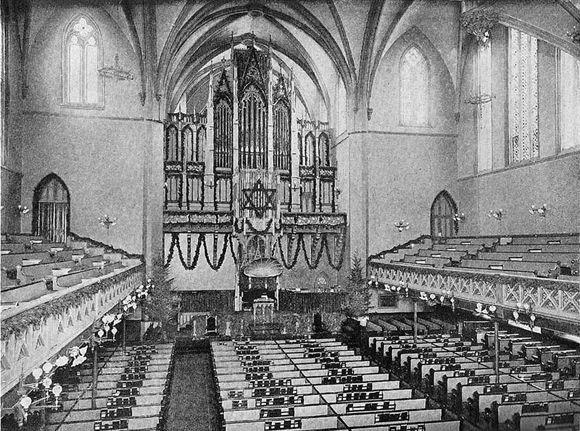
Broadway Tabernacle Church interior with a Ferris & Stuart organ, 34th Street, 1859. Image: via

In 1901, the church and congregation  moved to 57th Street and Broadway, and then later, again, this time to its present location at 93rd Street and Broadway. It is now called the Broadway United Church of Christ. In its place, at the NE corner of 34th Street and Broadway, the Marbridge building, an office building with retail space was built. 

The Marbridge Building, 1941. Image: MCNY


Other Sources:
1. Sir Charles Lyell, Eight Lectures on Geology
2. Library of Congress, Sojourner Truth online resources
3. Ward, Susan Hayes. The History of Broadway Tabernacle Church, 1901
4. Judd, Lewis Strong. The Broadway Tabernacle Church, 1901-1915

Wednesday, August 6, 2014

Empire Views

On March 17, 1930 construction began on the Empire State Building. It was built by the newly formed Empire State, Inc., who took their name from the moniker bestowed on New York State by George Washington in 1785. Designed by Shreve, Lamb & Harmon (who also created another 34th Street District treasure, the Gimbels Traverse) and built during the Great Depression, the new office tower became a symbol of perseverance and hope. E.B. White wrote of it in his 1949 essay "Here is New York": "The Empire State Building shot twelve hundred and fifty feet into the air when it was madness to put out as much as six inches of new growth."

It opened just over  a year later on May 1, 1931. Over 5,000 visitors stood in line at the street level on a rainy day to view the city from what was then the tallest man-made structure in the world (NYT, 1931-05-04).
Visitors to the 86th Floor on opening day, May 1, 1931. Image: tumblr
The 86th floor observation deck immediately became a popular destination for tourists. A photographer was on hand to capture the moment, which was then printed on a postcard.
Visitor Postcard photo taken on the Empire State Building observation deck, 86th Floor, May 8, 1934; front. Image: private collection (Pisark's)
Visitor Postcard photo taken on the Empire State Building observation deck, 86th Floor, May 8, 1934; back. Image: private collection (Pisark's)
Visitor Postcard, Empire State Building Observation Deck, 86th Floor, August 1935. Image: private collection (Pisark's)
Visitor Postcard, Empire State Building Observation Deck, 86th Floor, [1930s]. Image: Private collection (Pisark's)

Visitation to the observation deck increased throughout the 1930s and into the next decade, despite a few setbacks in the 1940s. On July 28, 1945 a B-25 Bomber crashed into the north side of the building during a routine personnel transport mission killing 14 people and injuring elevator operator Betty Lou Oliver. The building was re-opened the following Monday.


Just two years later, a photography student named Robert Wiles happened upon the aftermath of Evelyn McHale's suicide and took a photograph. The photo, published by LIFE magazine on May 1, 1947 is still regarded as one of the most poignant portraits of suicide.

Following this and other incidents, building management announced the forthcoming construction of an additional steel barrier along the building's parapet. A New York Times article also stated that during the Empire State Building's first 16 years of operation, there were 9,000 visitors, and only 15 suicides (with just one instance of injury to a pedestrian below) (NYT, 1947-05-11).

The steel barrier and parapet, 1948. Image: Private collection (Pisark's)

Though taller and larger buildings continue to rise throughout the city, the Empire State Building remains one of the city's greatest treasures, and receives nearly 3.6 million visitors a year.

Other Sources and Sites of Interest:
-Empire State Building Historical Timeline
-Empire State Building fact sheet
-Columbia University Avery Architecture and Fine Arts Library, Empire State Building Archive

Wednesday, December 11, 2013

Koster and Bial's Music Hall on 34th Street

Throughout the late 1800s Manhattan's Theater district crept northward along the city's Great White Way towards Times Square. Herald Square was home to several music and dance halls including Koster and Bial's. The theater's former location was a bit south at the corner of Sixth Avenue and 23rd Street. Two days after closing the 23rd Street location, John Koster and Albert Bial opened a new music hall with the same name on 34th Street between Seventh Avenue and Broadway.  On August 28, 1893 the hall opened its doors to the public, eight years before Macy's would buy the property, demolish the building, and build their famous flagship store.

Exterior of Koster and Bial's on the north side of  West 34th Street between Seventh Avenue and Broadway, 1896. Image: MCNY

Interior of the 34th Street Koster and Bial's Music Hall, 1896. Image: MCNY

Strobridge Lithographing, 1896. Image: LOC

A popular vaudeville venue with varied stage performances, Koster and Bial's hosted burlesque and acrobatic acts, as well as a whole host of musical performances.
Fannie Leslie [1896]. Image: NYPL
Trick horse of Emile outside the music hall's 34th Street entrance, 1896. Image: MCNY
Among the many dancers who made regular appearances at the venue, was "La Carmencita," also known as "The Pearl of Seville." Carmen Dauset was born in Seville, Spain in 1868, and began performing at the age of 12 in 1880. She made her American debut at the 23rd Street Koster and Bial's in February 1890, but performed several times at the 34th Street location.
The dancer as portrayed by painter William Merritt Chase, 1888. Image via

One of a few portraits painted of the dancer by painter John Singer Sargent, 1890. Image via
The theater was also the chosen location for the first exhibition of Thomas Edison's Vitascope projector on April 23, 1896. Originally invented by C. Francis Jenkins and Thomas Armant, and called a Phantoscope in 1895, the two inventors both claimed the invention as theirs after dissolving their partnership. It was soon sold to Thomas Edison, in what sounds like a similar situation to the Emile Berliner gramophone incident in the late 1870s. The Edison Manufacturing Company renamed the machine the Thomas Edison Vitascope, and continued manufacturing it.

The first theatrical exhibition of a a film projection machine, the Vitascope. April 23, 1896 Image: LOC

Edison's company went on to produce 100s of "actuality" films -- watch them -- documenting real life scenes with little or no narrative. Here is a film of Carmencita made in 1894, most likely with one of Edison's previous camera inventions: the kinetograph or kinetoscope:


Almost since the day it opened, the theater was plagued with financial and management issues. On July 17, 1901 Macy's announced the purchase and future demolition of the property to make way for the flagship store at 34th Street and Broadway. Three days later, Koster and Bial's held their last performance on the rook garden, ending with a chorus of performers and loyal customers singing "Auld Lang Syne."

You can still find a plaque commemorating the Hall's existence just outside the 34th Street entrance to Macy's.

Other Sources:
-Snyder, Robert. The Voice of the City: Vaudeville and Popular Culture in New York.

Monday, May 6, 2013

Saks and Gimbels on Sixth

This post also appears on Fashion Herald.

A few years before the ground broke for Penn Station, construction was underway in Herald Square for a retailer new to the city: Saks. The company, founded by Baltimore merchant Andrew Saks, chose Herald Square as the location for its first New York store in part, because of its proximity to the Sixth Avenue elevated train and rumored Penn Station. Along with Macy's and a little later, Gimbels, these major stores would soon redefine Herald Square as a retail hub of the city.

View from Greeley Square, looking north at Herald Square, around 34th Street and Broadway, 1901. Image: MCNY

The Saks building, designed by architecture firm Buchman & Fox, the same firm that would later design the World's Tower building on West 40th Street. Though Saks and Macy's were more or less neck and neck with their store construction and opening announcements, Saks still managed to open its doors just five weeks before Macy's in 1902. Unlike Macy's, a store composed of several departments, Saks in the early 1900s sold only clothing, making it not quite a true department store. Around the same time, one avenue over, Benjamin Altman was purchasing lots on Fifth and 34th to build his new store B. Altman & Co.

The completed Saks building at West 33rd Street with its competitor Macy's one block north at West 34th Street, 1902. Image: MCNY
Those two coexisted, offering consumers slightly different inventories -- Saks was an upscale clothing-based retailer, and Macy's catered to the general consumer with a large variety of merchandise-- until 1909, when another large retailer, Gimbels, joined the fray. Founded by Adam Gimbel in Vincennes, Indiana, Gimbels built its first large store in Philadelphia, PA, before constructing a New York branch just one block south of the Saks store, on Sixth Avenue between 32nd and 33rd Streets. Three large department stores in a row + public transportation = retail district.

Gimbels store at Sixth Avenue, between 32nd and 33rd Streets, 1912, thirteen years before the Gimbels Traverse was built. Image: MCNY

Model wearing a Gimbels dress, 1914. Image: LOC

Similar to Macy's, Gimbels was a large department store and family business.  Adam Gimbel had several sons, many of whom worked for the Gimbels Company: Isaac Gimbel became President in 1894, and was the driving force behind the store's expansion to the New York market; that same year, Ellis Gimbel took over Public Relations and advertising for the company. In 1921, he started the first Thanksgiving Parade in Philadelphia, PA, three years before Macy's began its iconic parade in New York City.

The company purchased Saks in 1923, and one year later, created the Saks Fifth Avenue brand, and opened its first store. The 34th Street location was kept open, and the Saks 34th brand was created. High end retail was moving farther north along Fifth Avenue, and the building's out-of-date construction (it didn't have escalators) were key factors in the decision to close the store in 1965.

Looking north from Greeley Square with the Gimbels and Saks buildings on the left, [1965]. Postcard: Anne

In 1967, discount retailer Korvette's moved into the Saks building. They "modernized" the facade, as seen below. Founded in 1947 by Eugene Ferkauf in a small store on Fifth Avenue and West 47th Street, Korvette's expanded quickly, with 2,684 stores in operation by the mid-1960s. This decade also saw a general rise in the national presence of discount retailers.

Same view as above, [1969]. Postcard: Anne
Gimbels stayed open until 1986. When it finally closed, it was cited as the store with the largest shoplifting rate of any in the country, largely because of the Gimbels Corridor. Originally built as a convenience to shoppers, the underground passageway connected the store to Penn Station a couple blocks away, and provided shoplifters with an easy escape. By the 1970s, the corridor had a horrible reputation and was the scene of more than a few gruesome crimes. This very opinionated description from a NY Post  article (are there any other kinds of NY Post articles?) pretty much sums it up: "In the midst of teeming Midtown, bare-bulb fixtures like those in mines marked a path through a Calcutta-like sprawl of diseased, predatory humanity."

After Gimbels closed, the building was renovated, and in 1989, reopened as A&S Plaza, and is now the home of JC Penney and the Manhattan Mall. Next door, the Saks building, now the Herald Center Mall, is slated for yet another makeover.


Thursday, April 18, 2013

B. Altman's Palace of Trade Moves Uptown

This post also appears on Fashion Herald.

Retailer Benjamin Altman of Altman & Co. opened his first large store in 1886 at Sixth Avenue and 19th Street. Though he previously occupied smaller stores in various parts of the city, this location was quickly dubbed "Palace of Trade" for its vast inventory and size. Business was great, and soon Altman was looking to expand yet again. Noticing the increasing numbers of mansions appearing along Fifth Avenue, he chose the corner of  West 34th Street and Fifth Avenue for the new flagship location of his store. At the time, the area was quiet, residential, and didn't look at all like it would support a large retail outlet.

34th Street looking east from Fifth Avenue, 1870. Image: NYHS

Altman purchased his first lot under an employee's name (Benjamin Jenkins) rather than his own, on the SE corner of Fifth Avenue and 34th Street in 1892. Shortly after, he set up the Wallingford Realty Company to handle all future transactions. Between 1892 and 1904, the company brokered a total of 28 purchases and long-term leases on behalf of Altman, gradually taking control of almost the entire block between 34th and 35th Streets and Madison and Fifth Avenues. By the time construction of the new building began in 1905, there was still one "holdout" building on the corner of 34th Street and Fifth Avenue, occupied by the Knoedler Gallery. Altman would have to wait another five years to acquire that property and expand the store all the way to Madison Avenue. In the meantime, on October 6, 1906 the new store opened for business.
Corner of 35th Street (left) and Fifth Avenue looking SE, 1906. The shorter building to the far right is the "holdout" property at 34th Street and Fifth Avenue. Image: LOC
The gallery held onto their corner until their lease ended in 1910 and they were forced to give up the property. Altman wasted no time on the store expansion he'd envisioned many years prior. He died just before the full-block expansion was completed in 1913, but just after he founded the philanthropic organization, the Altman Foundation.
 
Corner of Fifth Avenue (left) and 34th Street (right), just after the building's addition along Madison Avenue, about 1915. Image: MCNY
The interior of the Altman store was designed in a Palazzo style reminiscent of the Parisian Bon Marché, one of the world's first department stores. Skylights filtered light into the center of the main arcade, and steps led customers to multiple levels of departments that sold just about everything imaginable. A consummate traveler, Altman was known to go on yearly buying trips around the world in search of new and diverse merchandise.

Interior of the B. Altman arcade, 1908 Image: NYPL
Most, if not all, of the extensive bronze and iron work in the building was done by Brooklyn-based company Hecla Bronze and Iron Works. NYPL has several images in their digital archive of the Hecla Bronze and Iron Works building -- which thankfully is landmarked -- including their showroom with vaulted ceilings.


B. Altman & Co. was primarily known for catering to a well-off female customer. One who could spend hours looking at furs:

Selling floor for furs, 1914. Image: NYPL
And one who pursued the latest fashion trends. I was possibly born in the wrong century. I would wear all of these blouses today, right now.

Page from the B. Altman & Co. 1913 Summer Apparel catalog. Image: Duke University
The prude in me wishes bathing suits would move a little back in time and cover more skin like the ones shown here. The one second from the left is especially fetching. Bonus: all the lady ones are work-appropriate by today's standards! And black -- so much black! (I love it).

Page from the B. Altman & Co. 1913 Summer Apparel catalog. Image: Duke University
Aside from being at the forefront of fashion, Altman's was known for popularizing retail business practices that would eventually become commonplace. The best example is the story of the extremely wealthy and miserly Hetty Green (pictured here and here) purchasing a bolt of fabric from the Altman's at Sixth Avenue between 18th and 19th streets sometime in the mid-1800s, and then deciding she didn't like it. Returning merchandise was not accepted practice, but Mrs. Green went back to the store and asked for an exchange or her money back. Altman himself granted the return and she was so grateful that she vowed to act as guarantor to any future business loans. He never took her up on her offer, but they did stay in touch, and she introduced Altman to several of her financier acquaintances, who in turn got him interested in art collecting. Over the years, Altman amassed a 
massive art collection, now housed at the Metropolitan Museum of Art in NYC. You can read the collection handbook here and see some of the pieces here.

After several more successful decades, the Altman company was forced to sell the store to the L.J. Hooker Retail Group in 1985 and close the building in 1989. Today, the building is primarily occupied by City University of New York (CUNY) Graduate Center, and the NYPL Science, Industry, and Business Library (SIBL), but from the outside it still looks like a palace of trade.

Other Sources:
-Altman Company Department Store Building, 335-371 Fifth Avenue. Landmarks Preservation Commission, March 12, 1985; designation list 176, LP-1274
-Bruce, John S. Jr. 100 The First Century: A History of B. Altman & Co.
-Hendrickson, Robert. The Grand Emporiums: The Illustrated History of America's Great Department Stores.
-Zola, Emile. The Ladies' Paradise.
-Department Store museum website